
Object Details
Manufacturer
American Propeller and Manufacturing Company
Physical Description
Type: Two-Blade, Fixed-Pitch, Wood
Diameter: 304.8 cm (120 in.)
Chord: 28.6 cm (11.25 in.)
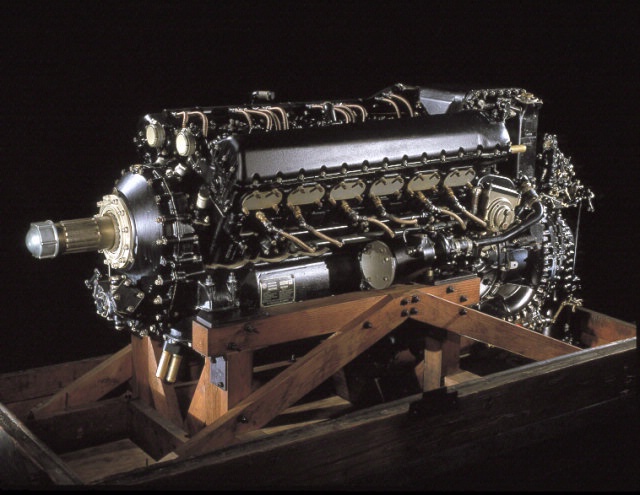
Engine Application: Liberty 298 kw (400 hp), water-cooled, V-12
Summary
An early predominant manufacturer in the United States, Spencer Heath's American Propeller and Manufacturing Company opened in Baltimore in 1909. Heath was first to use machines for mass production of aircraft propellers and, under the Paragon trademark, these were widely used in World War I. Like most propellers of that era, construction was a wood laminate because of light weight, strength, fabrication ease, and resistance to fatigue in a vibrating and flexing environment.
Heath demonstrated the first "engine-powered, engine-controlled, variable and reversible pitch propeller" in 1919, but was unsuccessful in convincing the Army of the practicality of the concept. He sold the company to the Bendix Corporation in 1929 and retired from aeronautics two years later.
This artifact is identical to tractor propellers built in 1919 for the US Navy's NC-4, the first aircraft to cross the North Atlantic, which is on display at the National Naval Aviation Museum in Pensacola, FL.
Credit Line
Gift of American Propeller & Manufacturing Co.
Inventory Number
A19300034000
Restrictions & Rights
Usage conditions apply
Type
PROPULSION-Propellers & Impellers
Materials
Wood
Varnish
Steel
Copper Alloy
Dimensions
Rotor/Propeller: 304.8 x 28.6 x 26.7 x 18.4cm (10 x 11 1/4 x 10 1/2 x 7 1/4 in.)
3-D: 304.8 x 26.7 x 27.3cm (10 x 10 1/2 x 10 3/4 in.)
Country of Origin
United States of America
See more items in
National Air and Space Museum Collection
Data Source
National Air and Space Museum
Link to Original Record
Record ID
nasm_A19300034000