
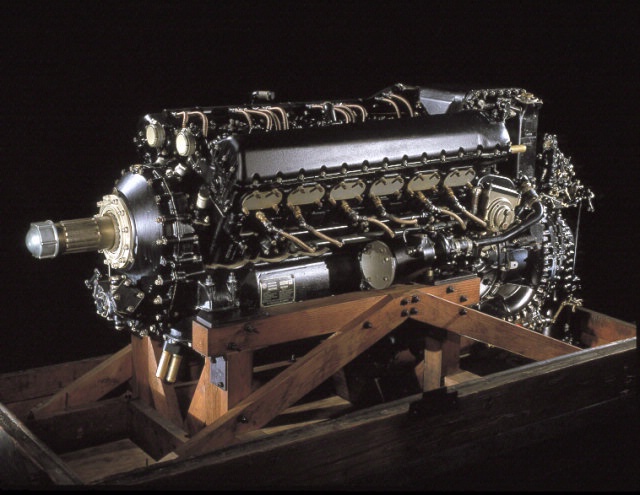
Object Details
Manufacturer
Allison Division, General Motors Corporation
Physical Description
Type: Turboprop with regenerator
Power Rating: 3,654 kW (4,900 eshp)
Compressor: 14-stage axial
Combustor: Cannular
Turbine: 4-stage axial
Weight: 709 kg (1,564 lb)
Summary
The T78-A-2 was originally designed as a potential replacement for the Allison T56 turboprop in the Lockheed P-3A ASW aircraft. It was also adaptable to airborne early warning aircraft based on Navy carriers, for large transports, and other applications where long endurance or low fuel consumption was of prime importance.
The T78 incorporated a regenerator system that was intended to reduce specific fuel consumption at low power settings and, thus greatly extend long-range and "on station" capabilities. The basic principle of regeneration involved reclamation of turbine exhaust heat to increase the temperature of compressor discharge air, thus reducing the amount of fuel required for the most efficient engine operating temperature.
By the spring of 1965, Allison had run the T78 at up to 85% of rated power during a one-hour test. Testing continued for a short period, but the engine was not put into production. Apparently some people in the Navy were opposed to increasing time on station for the P-3 because of crew fatigue problems.
Credit Line
Transferred from the U.S. Navy, Naval Air Systems Command, Washington, D.C.
Date
Circa 1964
Inventory Number
A19840407000
Restrictions & Rights
Usage conditions apply
Type
PROPULSION-Turbines (Jet)
Materials
HAZ MAT: Cadmium
Aluminum Alloys
Ferrous Alloys
Non-Magnetic White Metals
Paints
Plastics
Dimensions
3-D: 433.1 × 97.2 × 157.5cm (14 ft. 2 1/2 in. × 3 ft. 2 1/4 in. × 5 ft. 2 in.)
Storage (Wooden Crate): 121.3 × 459.7 × 213.4cm (3 ft. 11 3/4 in. × 15 ft. 1 in. × 7 ft.)
Country of Origin
United States of America
See more items in
National Air and Space Museum Collection
Data Source
National Air and Space Museum
Link to Original Record
Record ID
nasm_A19840407000