
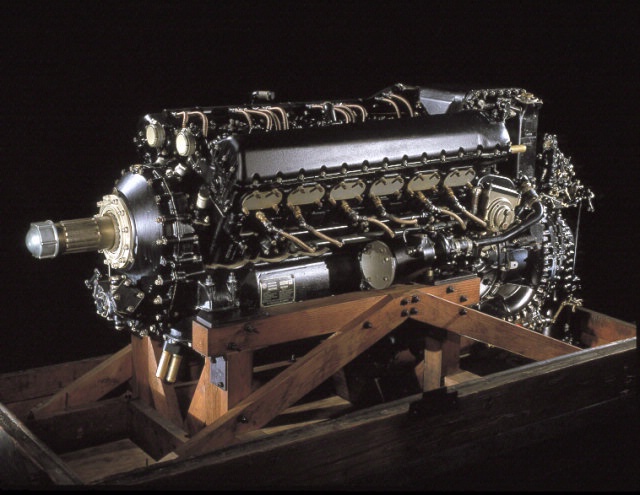
Object Details
Manufacturer
Air Technical Arsenal, Japan
Physical Description
Type: Turbojet
Thrust: 8,336 N (1,874 lb) at 12,000 rpm
Compressor: 4-stage axial, single-stage radial
Combustor: Annular
Turbine: Single-stage axial
Summary
Japanese turbojet development began in 1942 at the First Air Technical Arsenal in Hadano, and employed centrifugal compressors. The first of these was undesignated, but served as a prototype for the TR-10, which was to be used in the twin-engine "anti-invasion" bomber Kikka. The designation TR meant Turbine-Rocket and was the Japanese term for aircraft turbine engine.
The TR-12 followed a compressor development pattern similar to German Heinkel-Hirth engines, and represented an improved TR-10 with four axial compressor stages added. The TR-12 was considered to be too heavy. Under development between 1943 and 1944, the TR-30 was an enlarged TR-12B.
In July 1944, photographs of the German BMW 003 turbojet engine arrived by submarine. A companion sub containing production drawings was sunk enroute. Four engines evolved from these photos, including the Ne 20 by the Air Technical Arsenal. Like other Japanese engines, the TR-30 was abandoned in favor of the Ne 20.
Credit Line
Transfer from Untied States Army Air Forces
Date
Circa 1944
Inventory Number
A19670002000
Restrictions & Rights
Usage conditions apply
Type
PROPULSION-Turbines (Jet)
Materials
Wood
Steel
Adhesive
Paint
Felt
Dimensions
Length 246.4 cm (97 in.), Diameter 106.7 cm (42 in.)
Country of Origin
Japan
See more items in
National Air and Space Museum Collection
Data Source
National Air and Space Museum
Link to Original Record
Record ID
nasm_A19670002000