
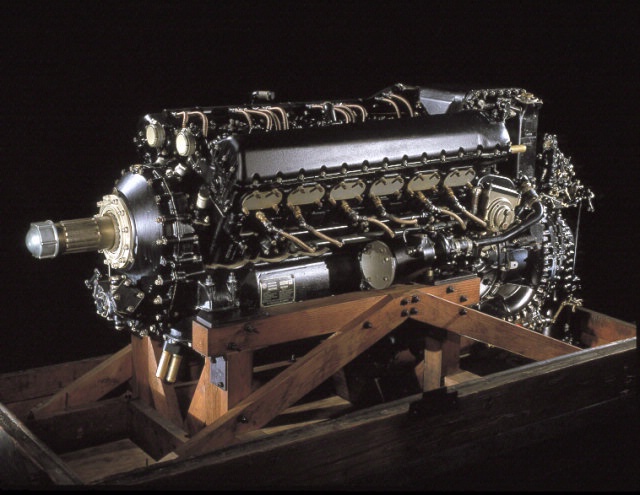
Object Details
Manufacturer
A.B.C. Motors (London, England)
Physical Description
Type: Reciprocating, 2 cylinders, opposed, air-cooled
Power rating: 34 kW (45 hp) at 1,800 rpm
Displacement: 2.28 L (139 cu in)
Bore and Stroke: 110 mm (4.33 in.) x 120 mm (4.72 in.)
Weight: 52.2 kg (115 lb)
Summary
Formally founded in 1912, ABC (formerly the All British Engine Company) Motors Ltd. entered both the motorcycle and aircraft engine business. Its early engines were water-cooled vertical and V-type types having four to sixteen cylinders. A Sopwith biplane powered by the four-cylinder vertical model won the 1912 Michelin Cup race.
Although ABC’s later air-cooled radial models were a failure because of poorly designed cylinders that overheated, the same cylinder design did work well in the smaller, opposed type Gnat, first manufactured during World War I. The Gnat powered the Penguin trainer, B.A.T.F.K.28 Crow, Blackburn Sidecar, Grain (P.V.7) Kitten, and Sopwith Bee/Tadpole/Sparrow aircraft. Produced in both geared and direct drive versions, its success led to the somewhat smaller Scorpion I and Scorpion II in the 1920s. The larger Hornet of 1924, a flat-four type, used the Scorpion cylinders. During World War II, ABC produced auxiliary power units.
Credit Line
Transferred from the Department of the Navy, Bureau of Aeronautics, Washington, D.C.
Date
Circa1913
Inventory Number
A19520102000
Restrictions & Rights
Usage conditions apply
Type
PROPULSION-Reciprocating & Rotary
Materials
Steel, Aluminum, Paint, Copper
Dimensions
3-D (Engine): 96.5 × 50.8 × 40.6cm, 33.1kg (3 ft. 2 in. × 1 ft. 8 in. × 1 ft. 4 in., 73lb.)
3-D (Aluminum Pallet Storage): 121.9 × 121.9 × 48.3cm, 55.3kg (4 ft. × 4 ft. × 1 ft. 7 in., 122lb.)
Country of Origin
United Kingdom
See more items in
National Air and Space Museum Collection
Data Source
National Air and Space Museum
Link to Original Record
Record ID
nasm_A19520102000