

Object Details
demonstrator
Morse, Samuel Finley Breese
Vail, Alfred
maker
Vail, Alfred
Morse, Samuel Finley Breese
Description
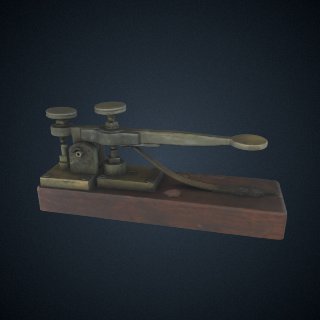
Alfred Vail made this key, believed to be from the first Baltimore-Washington telegraph line, as an improvement on Samuel Morse's original transmitter. Vail helped Morse develop a practical system for sending and receiving coded electrical signals over a wire, which was successfully demonstrated in 1844.
Morse's telegraph marked the arrival of instant long-distance communication in America. The revolutionary technology excited the public imagination, inspiring predictions that the telegraph would bring about economic prosperity, national unity, and even world peace.
Credit Line
from Western Union Telegraph Co.
Date made
1844
used date
1844
ID Number
EM.181411
catalog number
181411
accession number
31652
Object Name
telegraph transmitter
telegraph key
Physical Description
wood (overall material)
brass (overall material)
Measurements
overall: 3 in x 2 in x 6 3/4 in; 7.62 cm x 5.08 cm x 17.145 cm
Place Made
United States: New Jersey, Morristown
used
United States: Maryland, Baltimore
United States: District of Columbia, Washington
Related Publication
Kendrick, Kathleen M. and Peter C. Liebhold. Smithsonian Treasures of American History
See more items in
Work and Industry: Electricity
Government, Politics, and Reform
Engineering, Building, and Architecture
Work
Communications
Computers & Business Machines
Industry & Manufacturing
American Enterprise
National Treasures exhibit
Artifact Walls exhibit
Exhibition
American Enterprise
Exhibition Location
National Museum of American History
Data Source
National Museum of American History
Link to Original Record
Record ID
nmah_1096762
