

Object Details
wearer
Bradford, Ellen Jane Knight
Description
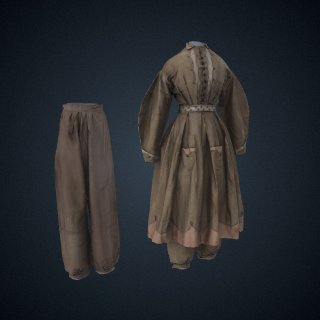
This exercise suit, donated by Faith Bradford (1880-1970) in 1955, belonged to her mother Ellen Jane Knight Bradford (1839-1899). Ellen Jane Knight, known familiarly as “Nellie,” was the niece of Massachusetts lieutenant governor Horatio Gates Knight, and lived in his household after her mother died. She graduated from Williston Seminary (now the Williston Northampton School), a co-educational academy, and taught music. In 1865 she married James Henry Bradford, who served as a chaplain in the Union Army before becoming a Congregational minister. They lived in various places in the northeast, usually pursuing work in education, and moved to Washington, D.C. in 1881. Ellen Bradford was educated and of a creative as well as Protestant reformist bent, publishing poems and hymns, serving as a correspondent for the paper The Congregationalist, and founding with her spouse the Industrial School for Girls in Middletown, Connecticut in 1868. In 1887 she became known for creating and directing a tableau based on the bestselling 1880 novel Ben Hur: A Tale of Christ to raise money for the homeopathetic hospital in Washington, D.C.
Bradford likely wore this exercise suit in the early 1860s, perhaps before she married. Such attire was adopted by some reform-minded, educated women of the middle and upper class (such as Bradford), mainly in the Northeastern U.S. as an alternative to long, heavy dresses underpinned by crinolines and tightly-laced corsets that typified women’s fashion in the mid nineteenth century. Consisting of a dress or tunic over long pants, what became known as the Bloomer dress earned its name from temperance and women’s rights activist Amelia Bloomer who donned and promoted it. It gained popularity in the 1850s but also drew the ire of critics who deemed the outfit unfeminine— “pants” for women—likely due in part to the public, activist behavior of some of its wearers. Yet reformers looking to improve American society, often focusing on individuals and their personal habits, championed the outfit as comfortable and beneficial to women’s health, allowing for freedom of breath and movement. This exercise suit, made of wool, would have been suitable for calisthenics and other activities outdoors, an important tenet of health reform, perhaps even during the winter in Massachusetts, where Bradford lived. Although chiefly utilitarian, it includes some stylistic details.
Location
Currently not on view
Credit Line
Faith Bradford
Date made
1855 - 1865
ID Number
CS.058323
catalog number
058323
accession number
205244
Object Name
Gymnasium Suit, 3-Piece
Other Terms
Gymnasium Suit, 3-Piece; Entire Body; Main Dress; Female; Exercise
Measurements
part, bottom: 40 in x 28 in; 101.6 cm x 71.12 cm
part, inseam: 24 in; 60.96 cm
part, dress, flat: 48 in x 37 in; 121.92 cm x 93.98 cm
part, armpit to cuff: 18 in; 45.72 cm
associated place
United States: Massachusetts, Easthampton
See more items in
Home and Community Life: Costume
Clothing & Accessories
Data Source
National Museum of American History
general subject association
Women's History
Women's Health
Reform
Fashion
Exercise
Link to Original Record
Record ID
nmah_363781
