


Object Details
Artist
Ferdinand Pettrich, born Dresden, Germany 1798-died Rome, Italy 1872
Sitter
Tecumseh
Gallery Label
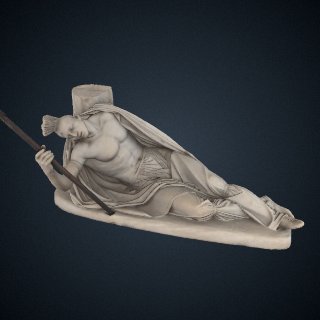
Tecumseh (Shawnee, 1768--1813) was a vital figure in the Native American resistance to U.S. expansionism after the Revolution. A warrior chief from the Ohio Valley, he worked to build a coalition of Indigenous nations that would block white settlers from encroaching further west. In the War of 1812 (1812--15), Tecumseh strategically allied his forces with the British but was killed by U.S. troops in the Battle of the Thames. The future president William Henry Harrison, who led that pivotal battle, recognized the formidable challenge Tecumseh's coalition would have posed to the United States, calling him, "one of those uncommon geniuses, which spring up occasionally to produce revolutions."
This sculpture emulates the ancient Roman sculpture the Dying Gaul, which similarly portrays a military adversary as heroic, yet exotic and powerless. A fictive portrait, it mythologizes Tecumseh as a timeless "noble savage," dangerously and erroneously suggesting that his death and the rapacious expansion of the United States were inevitable. The work stood in the U.S. Capitol from 1864 to 1878, a time when Congressional legislation profoundly impacted Indigenous sovereignties.
Exhibition Label
Who Was Tecumseh?
Shawnee warrior Tecumseh (1768--1813) led a powerful coalition of Indigenous nations to defend their homelands against the US military in the War of 1812. He died in battle after posing a formidable challenge to the US government.
The Myth of Tecumseh
This is a fictive portrayal of Tecumseh. Ferdinand Pettrich likely sculpted it around 1837 as political propaganda for Vice President Richard Mentor Johnson, whose campaign slogan proclaimed he killed the warrior. Depicted in flowing robes ill-suited for battle, Pettrich cast him as the "noble savage," a stereotypical trope that glorifies his warrior prowess while insisting his primitive nature spelled his downfall. This sculpture suggests that the devastation of Native peoples was natural and inevitable rather than the result of a strategic conquest.
In the US Capitol
This sculpture stood in the US Capitol from 1864 to 1878. It was seen by countless legislators as they consistently voted on policies that broke treaties made with Native nations.
At SAAM
Congress transferred the sculpture to the Smithsonian. For decades, SAAM has presented the sculpture surrounded by landscape paintings that celebrate American expansion, reinforcing its role as a romanticized symbol.
Since the colonization of the Americas, tribal leadership has fought for treaties to be honored and tribal sovereignty to be respected. The 1960s and '70s--concurrent with the 1968 display of Tecumseh--saw a groundswell of Indigenous activists challenging discriminatory US policies and broken treaties.
In 1969 the Indigenous activist group, "The Indians of All Tribes," occupied Alcatraz Island in a demonstration for the rights of Indigenous peoples and the return of stolen land. As part of a larger movement for Indigenous civil rights, some who participated in this occupation later joined the American Indian Movement. They fought against police brutality, economic inequality, and the removal of Indigenous children from their families by state child welfare and private adoption agencies. Later the movement would advocate for tribal sovereignty and the unification all Indigenous peoples.
Label text from The Shape of Power: Stories of Race and American Sculpture November 8, 2024 -- September 14, 2025
Label written by: Karen Lemmey, Anne Showalter, Julianna White, Tobias Wofford and Grace Yasumura
Credit Line
Smithsonian American Art Museum, Transfer from the U.S. Capitol
Date
modeled ca. 1837-1846, carved 1856
Object number
1916.8.1
Restrictions & Rights
CC0
Type
Sculpture
Medium
marble with painted copper alloy tomahawk
Dimensions
36 5/8 x 77 5/8 x 53 3/4 in. (93.1 x 197.2 x 136.6 cm.)
See more items in
Smithsonian American Art Museum Collection
Department
Painting and Sculpture
Data Source
Smithsonian American Art Museum
Topic
Indian
Figure male\full length
State of being\death
Portrait male
Link to Original Record
Record ID
saam_1916.8.1