
Two New Porcelain Crab Species Discovered
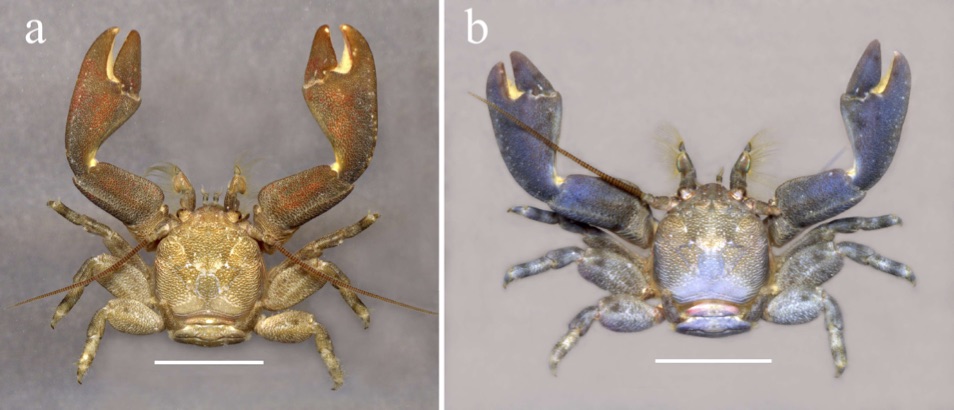
Although initially mistaken for Petrolisthes tonsorius in the 1970s, the uncommon colors and atypical habitat of Petrolisthes virgilius led the scientists to corroborate through genetic analyses that it was a new species.
Credit: Alexandra Hiller and Bernd Werding
Two new porcelain crab species have been described in the ZooKeys journal by scientists from the Smithsonian Tropical Research Institute (STRI) and the Institut für Tierökologie und Spezielle Zoologie der Justus-Liebig-Universität Giessen. One of the new species, Polyonyx socialis, was discovered in the South China Sea of Vietnam. The other, Petrolisthes virgilius, has a new identity, after initially being taken for a similar-looking species—Petrolisthes tonsorius—four decades ago in the Colombian Caribbean.
Porcelain crabs belong to a highly diverse family of marine crustaceans, distributed in the shallow waters of oceans worldwide. They also are known as “false crabs,” because they evolved a crab-like form independently of true crabs. A relatively large number of porcelain crab species are symbiotic with other organisms, allowing scientists to tell a story of a long-time relationship between species from distantly related taxa.
“Most porcelain crabs live on the hard substrates of shallow waters like the surface of corals or rocks overgrown by algae, microbes and decaying material,” said STRI research associate Alexandra Hiller, co-author of the papers. “Others live as symbionts of invertebrates like sponges, anemones, sea urchins, polychaete worms and other crustaceans.”
The two recently described species are examples of these symbiotic porcelain crabs. P. socialis derives its name from the Latin word for “social” because it was found living with other organisms—including the larger porcelain crab species, Polyonyx heok—in the compact tube-like shelters built by the polychaete worm Chaetopterus sp. Its broad, flat walking legs and claw-bearing extremities appear to have been adapted for living tightly-attached to the worm tube walls and avoid being perceived as an obstacle for the other organisms.
Although initially mistaken for P. tonsorius in the 1970s, the uncommon colors and atypical habitat of P. virgilius —intertidal vermetid snail formations in the Colombian Caribbean—led the scientists to corroborate through genetic analyses that it was a new species. As a symbiont, P. virgilius has evolved in tight association to its distinctive surroundings: a reef-like microhabitat exposed to wave action and consisting of snail shells cemented to each other and to a hard substrate.
Despite the relatively high number of known symbiotic porcelain crab species, such as P. socialis and P. virgilius, the researchers believe this aspect of their ecology could hinder their long-term survival, particularly in the shallow-water ecosystems where they typically occur. These habitats are often more vulnerable to climate change, ocean acidification and contamination.
“Symbiotic species are thought to be more vulnerable to environmental challenges than free-living organisms,” said Prof. Dr. Bernd Werding, from the Institut für Tierökologie und Spezielle Zoologie der Justus-Liebig-Universität Giessen, and co-author of the studies. “Their fate depends on the fate of their host, which may also be affected by local and global conditions and abrupt changes.”
Members of the research team are affiliated with the Smithsonian Tropical Research Institute and the Institut für Tierökologie und Spezielle Zoologie der Justus-Liebig-Universität Giessen. Research was funded by a Smithsonian postdoctoral fellowship. The authors thank H. Lessios, L. Geyer, L. Rivera and A. Calderón for support at STRI’s Naos Marine and Molecular Laboratory in Panama City, Panama, and T. Britayev from the Severtzov Institute of Ecology and Evolution, Russian Academy of Sciences, Moscow, and D. Martin from the Department of Marine Ecology, Centre d’Estudis Avançats de Blanes, Catalunya, for providing porcellanid material collected in Vietnam and for the photograph of the new species.
The Smithsonian Tropical Research Institute, headquartered in Panama City, Panama, is a unit of the Smithsonian Institution. The institute furthers the understanding of tropical biodiversity and its importance to human welfare, trains students to conduct research in the tropics and promotes conservation by increasing public awareness of the beauty and importance of tropical ecosystems.
# # #
Werding, B., Hiller, A. 2019. A new species of Polyonyx (Crustacea, Anomura, Porcellanidae) inhabiting polychaete-worm tubes (Annelida, Chaetopteridae) in the Indo-West Pacific. Zookeys 818: 25-34. https://doi.org/10.3897/zookeys.818.30587
Hiller A, Werding B. 2019. A new species of Petrolisthes (Crustacea, Anomura, Porcellanidae) inhabiting vermetid formations (Mollusca, Gastropoda, Vermetidae) in the southern Caribbean Sea. ZooKeys 876: 143–151. https://doi.org/10.3897/zookeys.876.37244
SI-406-2019
