
Smithsonian Scientist Sheds Light on Origin of Martian Moons
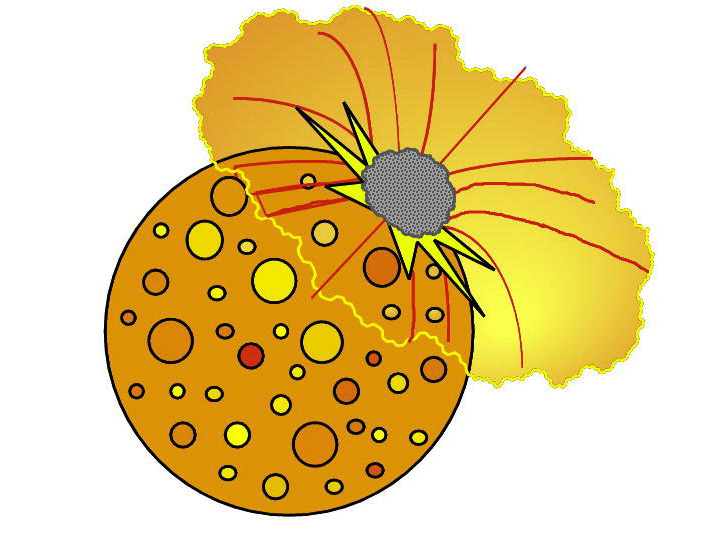
The Martian moons, Phobos and Deimos, may have been the result of a giant impact that sent rocks and debris into orbit around Mars, instead of asteroids that were captured by the planet’s gravity as previously thought. After going into orbit, the material from the giant impact aggregated and formed into small, low-mass moons. This collision could also account for why Mars spins on its axis. This theory is presented in an article by Smithsonian scientist Robert Craddock at the Center for Earth and Planetary Studies to be published in the Icarus International Journal of Solar System Studies.
In recent years a number of separate observations suggest that the Martian satellites were the result of giant impact. Similar to the Earth–Moon system, Mars has too much angular momentum; in both cases a giant impact may have caused the planets to spin on their axes. The giant impact on early Earth placed material into orbit that eventually formed the moon; it is likely that a giant impact on early Mars also placed material into orbit. Unlike what happened with the Earth’s moon, however, this material never coalesced into a single giant moon. Instead, a number of smaller moonlets formed. Over time the orbits of many of these moonlets probably decayed and ended up crashing onto the surface Mars until only two were left. This also explains the orbits of Phobos and Deimos. If they were captured asteroids, their orbits should be different and eccentric; their similar flat and circular orbits would be a natural consequence of having formed from material from a giant impact that was placed into orbit.
“Are Phobos and Deimos the Result of a Giant Impact?” will be published by Icarus International Journal of Solar System Studies and is available online at http://tinyurl.com/23m7kky.
The Center for Earth and Planetary Studies is the scientific research unit within the Collections and Research Department of the National Air and Space Museum. CEPS scientists perform original research and outreach activities on topics covering planetary science, terrestrial geophysics and the remote sensing of environmental change.
The National Air and Space Museum is on the National Mall in Washington, D.C., at Sixth Street and Independence Avenue S.W. The museum’s Steven F. Udvar-Hazy Center is located in Chantilly, Va., near Washington Dulles International Airport.
# # #
SI-531-2010

