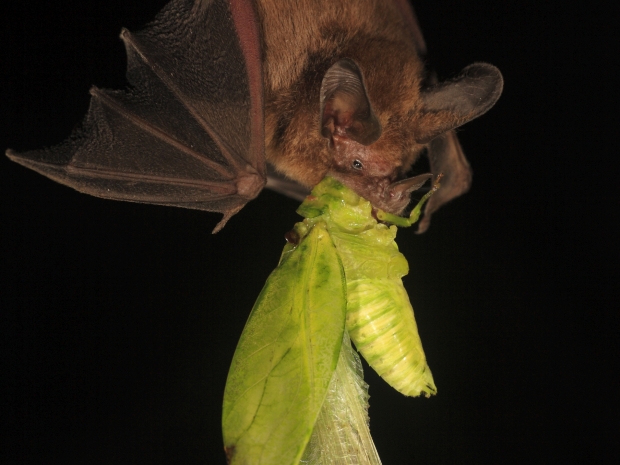
Risky Business: Courtship Movements Put Katydids in Danger

Christian Ziegler
Reproduction can be risky. In the case of katydids, some hunting bats eavesdrop on male mating calls to locate the insects, but little is known about the risk to mates as they move toward each other. A recent study by scientists at the Smithsonian Tropical Research Institute (STRI) and collaborating institutions explores the hunting behavior of a Neotropical bat, asking whether prey movement adds to the risk that they will be eaten.
Inga Geipel, a Tupper postdoctoral fellow at STRI and one of the lead authors on the study published in Biology Letters, and her colleagues observed the predation behavior of Micronycteris microtis, a gleaning bat species that loves to eat katydids, as it responded to different prey behavior. Common in Central and South America, M. microtis can detect silent and motionless prey through echolocation alone.
“I previously showed the surprising ability of M. microtis to find motionless prey and explained how they do it,” Geipel said. “But I kept wondering whether movement would actually increase the risk that an insect would be found.”
“From graduate student Ciara Kernan and Hannah ter Hofstede, Dartmouth assistant professor and STRI research associate, both experts on insect communication, I learned more about the way that katydids use vibrational signals during courtship,” Geipel said. “Also, the mates need to move toward each other, creating an inevitable cue that could be picked up by a predator using echolocation.”
Alongside Ciara Kernan and STRI intern Amber Litterer, Geipel placed bats in a flight cage and used models that simulated motionless, vibrating or walking katydids. The experiment showed that M. microtis preferred walking katydid models to still or vibrating ones. They also chose vibrating models over motionless prey and scanned moving prey for longer periods of time.
“Our study suggests that not only signalers, but also searchers may be at risk,” Geipel said. “Both male and female katydids are prone to predation during a courtship interaction as they move toward each other.”
For the team, this finding also opens new avenues for future research, as researchers explore yet new prey-finding strategies of gleaning bats and predator avoidance schemes of Neotropical katydids.
“Bats are such key players in our ecosystems, playing critical roles as pollinators, seed dispersers and forest regenerators,” said Rachel Page, STRI staff scientist and co-author. “And one of their most important roles is insect control. Here we see that bats are even more effective insect hunters than we previously knew. Not only can they effectively pick herbivorous insects off of leaves in the cluttered understory of the rainforest at night, they can successfully attend even to very small movements, placing yet more pressure on the courtship behavior of their katydid prey.”
Members of the research team are affiliated with STRI, the Department of Biological Sciences at Dartmouth College and the Department of Evolution, Ecology and Organismal Biology at Ohio State University. Research was funded by STRI and Dartmouth College.
The Smithsonian Tropical Research Institute, headquartered in Panama City, Panama, is a unit of the Smithsonian Institution. The institute furthers the understanding of tropical biodiversity and its importance to human welfare, trains students to conduct research in the tropics and promotes conservation by increasing public awareness of the beauty and importance of tropical ecosystems.
# # #
Geipel, I., Kernan, E., Litterer, A.S., Carter, G.C., Page, R., ter Hofstede, H.M. (2020). Predation risks of signaling and searching: bats prefer moving katydids. Biology Letters. 16:20190837. http://dx.doi.org/10.1098/rsbl.2019.0837
SI-133-2020