
A Planet Is Forming in an Earth-like Orbit Around a Young Star
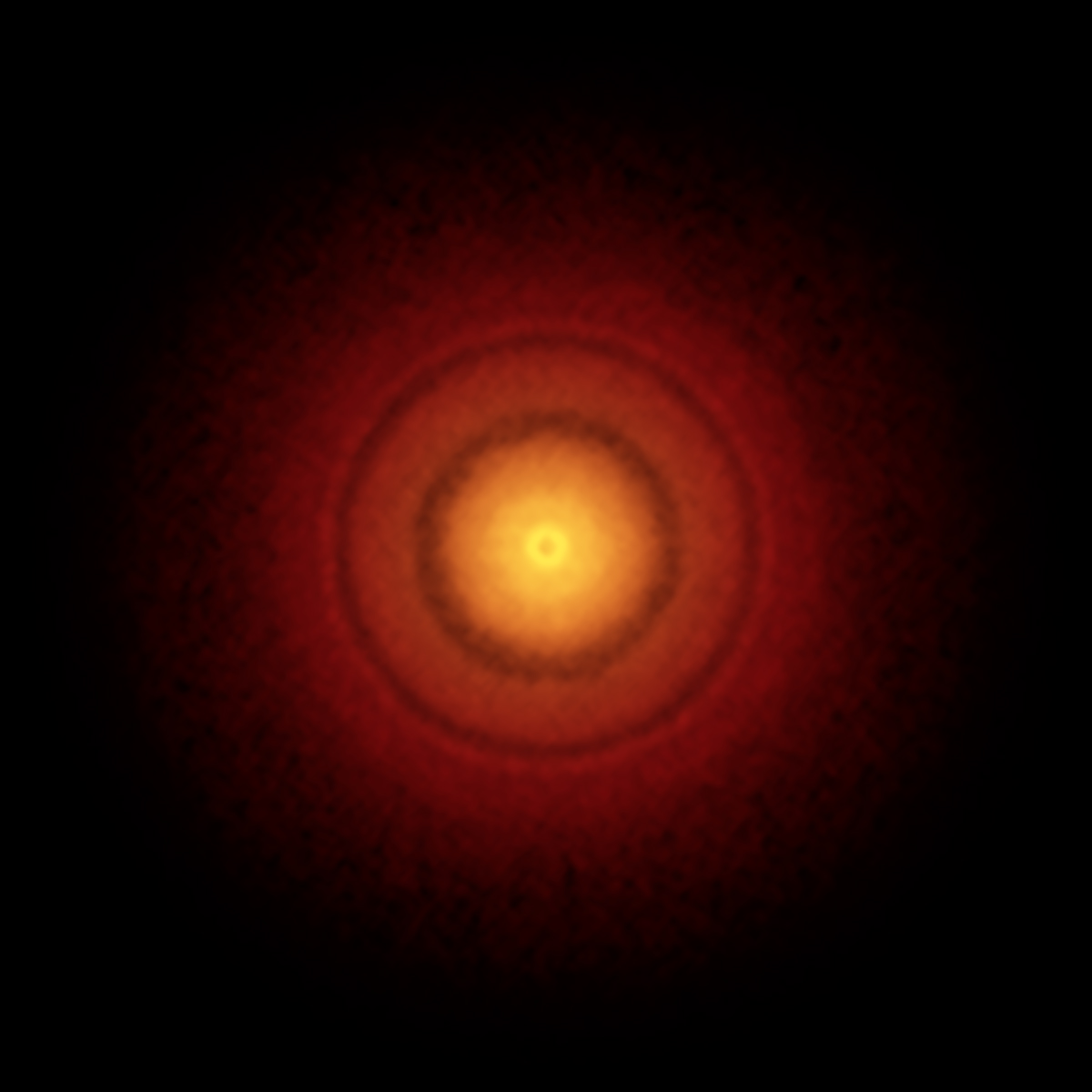
Disks of dust and gas that surround young stars are the formation sites of planets. New images from the Atacama Large Millimeter/submillimeter Array (ALMA) reveal never-before-seen details in the planet-forming disk around a nearby Sun-like star, including a tantalizing gap at the same distance from the star as the Earth is from the Sun.
This structure may mean that an infant version of our home planet, or possibly a more massive "super-Earth," is beginning to form there.
The star, TW Hydrae, is a popular target of study for astronomers because of its proximity to Earth (approximately 175 light-years away) and its status as a veritable newborn (about 10 million years old). It also has a face-on orientation as seen from Earth. This affords astronomers a rare, undistorted view of the complete disk.
"Previous studies with optical and radio telescopes confirm that this star hosts a prominent disk with features that strongly suggest planets are beginning to coalesce," said Sean Andrews of the Harvard-Smithsonian Center for Astrophysics, and lead author on a paper published in Astrophysical Journal Letters. "The new ALMA images show the disk in unprecedented detail, revealing a series of concentric dusty bright rings and dark gaps, including intriguing features that suggest a planet with an Earth-like orbit is forming there."
Other pronounced gap features are located at distances from the central star of 3 billion and 6 billion kilometers, similar to the distances from the Sun to Uranus and Pluto in our own Solar System. They too are likely the result of particles that came together to form planets, which then swept their orbits clear of dust and gas and shepherded the remaining material into well-defined bands.
For the new TW Hydrae observations, astronomers imaged the faint radio emission from millimeter-size dust grains in the disk, revealing details on the order of one astronomical unit (about 150 million kilometers, or the distance between the Earth and the Sun). These detailed observations were made possible with ALMA’s high-resolution, long-baseline configuration. When ALMA's dishes are at their maximum separation, up to 15 kilometers, the telescope is able to resolve finer details. "This is the highest spatial resolution image ever of a protoplanetary disk from ALMA, and that won't be easily beat going forward," said Andrews.
"TW Hydrae is quite special. It is the nearest known protoplanetary disk to Earth and it may closely resemble our Solar System when it was only 10 million years old," said co-author David Wilner, also with the Harvard-Smithsonian Center for Astrophysics.
Earlier ALMA observations of another system, HL Tau, show that even younger protoplanetary disks – a mere 1 million years old – can display similar signatures of planet formation. By studying the older TW Hydrae disk, astronomers hope to better understand the evolution of our own planet and the prospects for similar systems throughout the Galaxy.
The astronomers’ next phase of research is to investigate how common these kinds of features are in disks around other young stars and how they might change with time or environment.
This release is being issued jointly with the National Radio Astronomy Observatory (NRAO).
About the Harvard-Smithsonian Center for Astrophysics
Headquartered in Cambridge, Mass., the Harvard-Smithsonian Center for Astrophysics (CfA) is a joint collaboration between the Smithsonian Astrophysical Observatory and the Harvard College Observatory. CfA scientists, organized into six research divisions, study the origin, evolution and ultimate fate of the universe.
# # #
SI-172-2016

