
New Images Show Recent Geologic Activity on the Moon
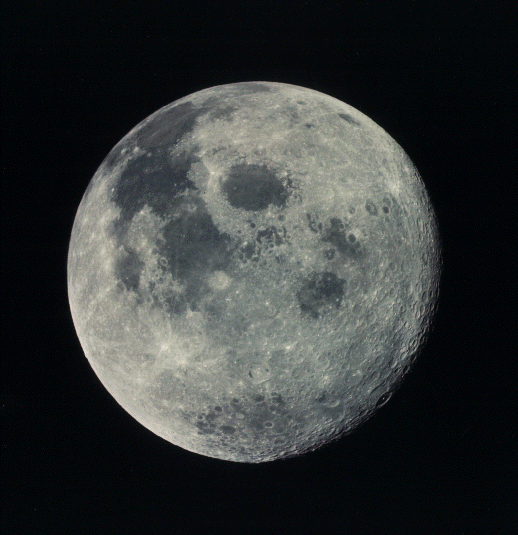
New images from NASA’s Lunar Reconnaissance Orbiter spacecraft show that the moon’s crust is being slightly stretched, forming small valleys—at least in some small areas. High-resolution images obtained by the Lunar Reconnaissance Orbiter Camera provide evidence that these valleys are very young, suggesting the moon has experienced relatively recent geologic activity. The findings are reported by a team from Arizona State University, Johns Hopkins University and the Smithsonian Institution, led by Smithsonian scientist Thomas Watters, in a paper, “Recent Extensional Tectonics on the Moon Revealed by the Lunar Reconnaissance Orbiter Camera,” appearing in the March issue of the journal Nature Geoscience.
In new LROC images, the team discovered small, narrow graben typically only hundreds to a few thousand meters (yards) long and tens to hundreds of meters wide, indicating the lunar crust is pulling apart at these locations. Graben are formed when the crust is stretched, breaks and drops down along two bounding faults, creating a trough or valley. The team proposes that the geologic activity that created the graben occurred less than 50 million years ago (very recent compared to the moon’s current age of more than 4.5 billion years).
In August 2010, the team reported the discovery of lobate scarps in the lunar crust using LROC images. They propose that these scarps indicate the moon shrank globally in the geologically recent past and might still be shrinking today. The team saw the scarps widely distributed across the moon and concluded that it was shrinking as its interior slowly cooled. The new images of graben therefore present a contradiction—regions of the lunar crust that are being pulled apart as the moon shrinks.
“We think the moon is in a general state of global contraction due to cooling of a still hot interior,” said Thomas Watters of the Center for Earth and Planetary Studies at the Smithsonian’s National Air and Space Museum. “The graben tell us that forces acting to shrink the moon were overcome in places by forces acting to pull it apart. This means the contractional forces shrinking the moon cannot be large, or the small graben might never form.”
“It was a big surprise when I spotted graben in the farside highlands,” said Mark Robinson of the School of Earth and Space Exploration at Arizona State University, coauthor and principal investigator of the LROC. “I immediately targeted the area for high-resolution stereo images so we could create a 3-D view of the graben. It’s exciting when you discover something totally unexpected. Only about half the lunar surface has been imaged in high resolution. There is much more of the moon to be explored.”
The small graben indicate that contractional forces in the lunar crust are relatively weak. The weak contraction indicates that unlike the terrestrial planets—Mercury, Venus, Earth and Mars—the moon did not totally melt in the very early stages of its evolution. Instead, an alternative scenario better fits the observations: only the moon’s exterior initially melted forming a magma ocean.
The research was funded by the LRO mission, currently under NASA’s Science Mission Directorate at NASA Headquarters in Washington.
The National Air and Space Museum building on the National Mall in Washington, D.C., is located at Sixth Street and Independence Avenue S.W. The museum’s Steven F. Udvar-Hazy Center is located in Chantilly, Va., near Washington Dulles International Airport. Both facilities are open daily from 10 a.m. until 5:30 p.m. (closed Dec. 25). Admission is free, but there is a $15 fee for parking at the Udvar-Hazy Center.
# # #
SI-67-2012


