
Human Shadow Cast Over the Caribbean Slows Coral Growth
Media Contact
Beth King
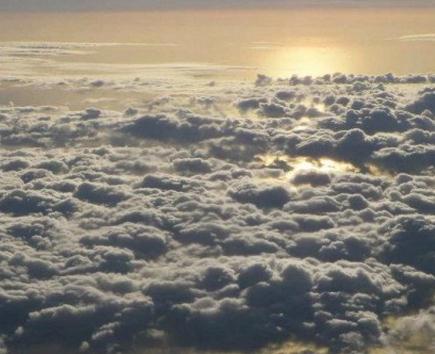
Striking Caribbean sunsets occur when particles in the air scatter incoming sunlight. But a particulate shadow over the sea may have effects underwater. A research team, including staff scientist Héctor Guzmán from the Smithsonian Tropical Research Institute, linked airborne particles caused by volcanic activity and air pollution to episodes of slow coral-reef growth.
Like tree rings, long-lived coral skeletons preserve a record of coral growth. Previously, scientists linked coral-growth patterns in the Caribbean to a phenomenon called the Atlantic Multi-decadal Oscillation—fluctuations in sea-surface temperatures and incoming sunlight.
In order to better predict the effects of climate change and human disturbance on reefs, Lester Kwiatkowski, University of Exeter, and researchers from the University of Queensland, the Australian Nuclear Science and Technology Organization and STRI analyzed coral-growth records from Belize and Panama spanning the period from 1880 to 2000. An Earth-system model simulation told them how well sea-surface temperature, short-wave radiation and aragonite-saturation state, a measure of ocean acidification, predicted changes in coral growth.
Their data came from several coral cores drilled in reefs near the Atlantic entrance of the Panama Canal formed by the coral species Siderastrea siderea between 1880 and 1989, whereas samples from the Turneffe atoll in Belize showed growth fluctuations in the coral species Montastrea faveolata from 1905 to 1998.
Particles from air pollution, primarily sulfate, reflect incoming sunlight and make clouds brighter, reducing the amount of sunlight reaching the sea surface. Coral growth corresponded closely to sea-surface temperatures and light levels. Growth fluctuations in the late 19th and early 20th centuries were largely driven by volcanic activity.
Researchers explain a dive in surface temperatures and coral growth in the 1960s by increased air pollution associated with post-World War II industrial expansion in North America and to a lesser extent in Central and South America.
The influence of human aerosol emissions was more pronounced in coral cores from Belize, perhaps because Belize is closer to sources of industrial emissions. Fluctuations unexplained by the model, especially in the growth records from Panama, probably result from runoff from deforestation and from the construction of the Panama Canal waterway.
“The coral growth chronology for Panama allowed us to identify the effects of human interventions at the beginning of 1900s, but the decline in growth observed by the middle of the 20th century corresponding to the beginnings of the industrial era in coastal Panama remained unresolved by the model,” said Guzmán.
“Our study suggests that coral ecosystems are likely to be sensitive to not only future global atmospheric carbon dioxide concentration but also to regional aerosol emissions associated with industrialization and decarbonization,” said Kwiatkowski.
The Smithsonian Tropical Research Institute, headquartered in Panama City, Panama, is a unit of the Smithsonian Institution. The Institute furthers the understanding of tropical nature and its importance to human welfare, trains students to conduct research in the tropics and promotes conservation by increasing public awareness of the beauty and importance of tropical ecosystems. Website: www.stri.si.edu.
# # #
SI-118-2013
Reference: Kwiatkowski, L., Cox, P.M., Economou, T., Halloran, P.R., Mumby, P.J., Booth, B.B.B., Carilli, J. and Guzman, H.M. 2013. Caribbean coral growth influenced by anthropogenic aerosol emissions. Nature Geoscience. doi:10.1038/ngeo1780 published online 7 April 2013.