High Schoolers Discover Four Exoplanets Through Harvard & Smithsonian Mentorship Program
High Schoolers-Turned-Scientists Published Their Findings This Week
They may be the youngest astronomers to make a discovery yet.
This week, 16-year-old Kartik Pinglé and 18-year-old Jasmine Wright have co-authored a peer-reviewed paper in The Astronomical Journal describing the discovery of four new exoplanets about 200 light-years away from Earth.
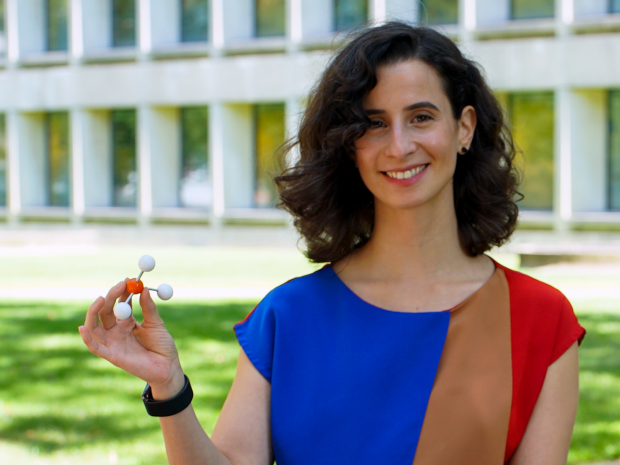
The high schoolers participated in the research through the Student Research Mentoring Program (SRMP) at the Center for Astrophysics | Harvard & Smithsonian. Directed by astrochemist Clara Sousa-Silva, SRMP connects local high schoolers who are interested in research with real-world scientists at Harvard and MIT. The students then work with their mentors on a yearlong research project.
“It’s a steep learning curve, but it’s worth it,” Sousa-Silva said. “By the end of the program, the students can say they’ve done active, state-of-the-art research in astrophysics.”
Pinglé and Wright’s particular achievement is rare. High schoolers seldom publish research, Sousa-Silva said. “Although that is one of the goals of the SRMP, it is highly unusual for high schoolers to be co-authors on journal papers.”
With guidance from mentor Tansu Daylan, a postdoc at the MIT Kavli Institute for Astrophysics and Space Research, the students studied and analyzed data from the Transiting Exoplanet Survey Satellite (TESS). TESS is a space-based satellite that orbits around Earth and surveys nearby bright stars with the ultimate goal of discovering new planets.
The team focused on TESS Object of Interest (TOI) 1233, a nearby, bright sun-like star. To perceive if planets were rotating around the star, they narrowed in on TOI-1233’s light.
“We were looking to see changes in light over time,” Pinglé said. “The idea being that if the planet transits the star, or passes in front of it, it would [periodically] cover up the star and decrease its brightness.”
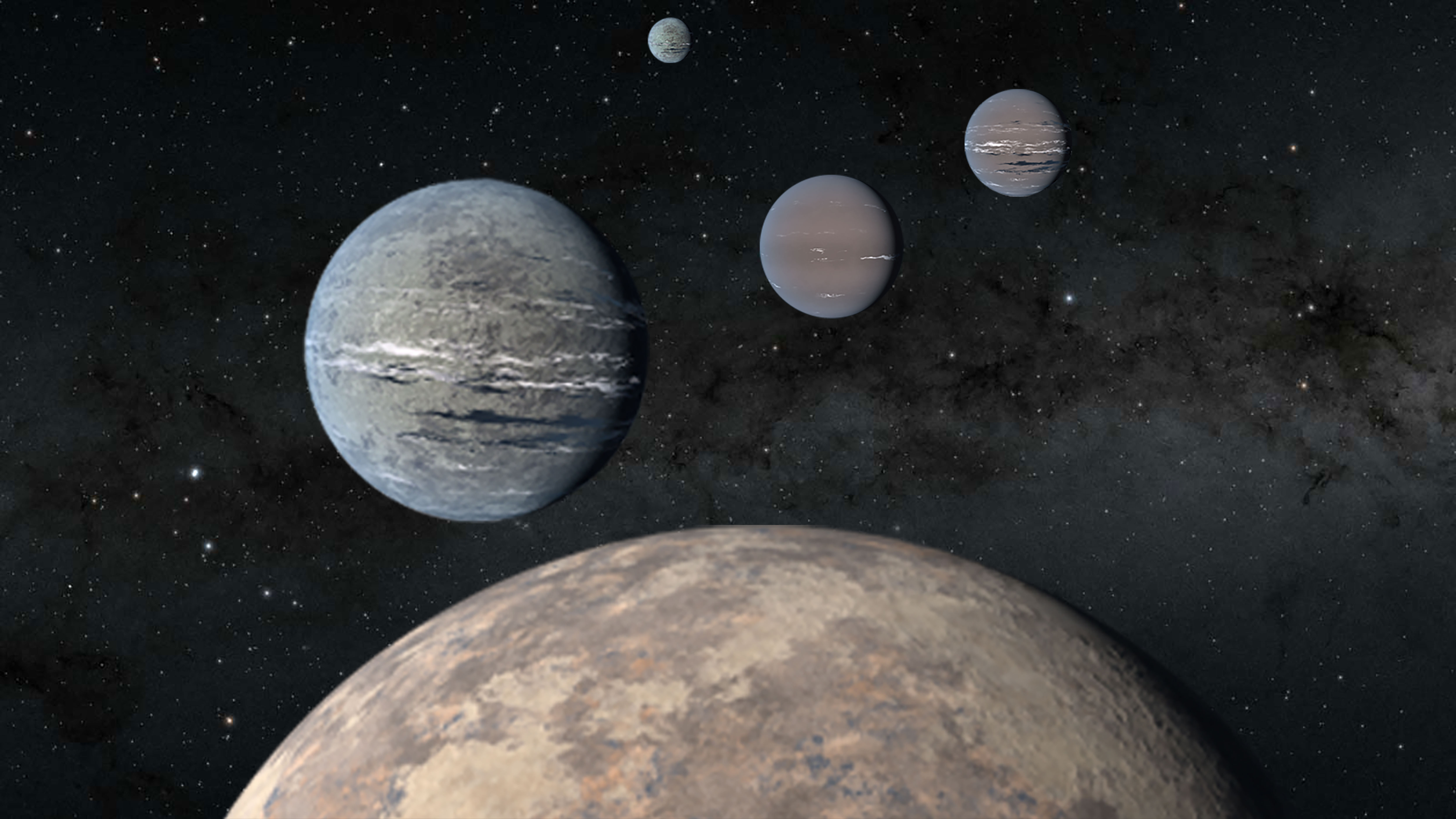
To the team’s surprise, they discovered not one but four planets rotating around TOI-1233.
“I was very excited and very shocked,” Wright said. “We knew this was the goal of Daylan’s research, but to actually find a multiplanetary system, and be part of the discovering team, was really cool.”
Three of the planets are considered “sub-Neptunes,” gaseous planets that are smaller than, but similar to Neptune. It takes between six and 19.5 days for each of them to orbit around TOI-1233. The fourth planet is labeled a “super-Earth” for its large size and rockiness; it orbits around the star in just under four days.
Daylan hopes to study the planets even closer in the coming year.
“Our species has long been contemplating planets beyond our solar system and with multi-planetary systems, you’re kind of hitting the jackpot,” he said. “The planets originated from the same disk of matter around the same star, but they ended up being different planets with different atmospheres and different climates due to their different orbits. So, we would like to understand the fundamental processes of planet formation and evolution using this planetary system.”
Daylan adds that it was a “win-win” to work with Pinglé and Wright on the study.
“As a researcher, I really enjoy interacting with young brains that are open to experimentation and learning and have minimal bias,” he says. “I also think it is very beneficial to high school students, since they get exposure to cutting-edge research and this prepares them quickly for a research career.”
The SRMP was established in 2016 by Or Graur, a former postdoctoral fellow at the Center for Astrophysics | Harvard & Smithsonian. The program accepts about a dozen students per year with priority given to underrepresented minorities.
Thanks to a partnership with the city of Cambridge, Massachusetts, the students are paid four hours per week for the research they complete.
“They are salaried scientists,” Sousa-Silva said. “We want to encourage them that pursuing an academic career is enjoyable and rewarding—no matter what they end up pursuing in life.”
Pinglé, a junior in high school, is considering studying applied mathematics or astrophysics after graduation. Wright has just been accepted into a five-year master of astrophysics program at the University of Edinburgh in Scotland.
About the Center for Astrophysics | Harvard & Smithsonian
The Center for Astrophysics | Harvard & Smithsonian is a collaboration between Harvard and the Smithsonian designed to ask—and ultimately answer—humanity’s greatest unresolved questions about the nature of the universe. The Center for Astrophysics is headquartered in Cambridge, Massachusetts, with research facilities across the U.S. and around the world.
# # #
SI-25-2021