
Even Fake Illness Affects Relationships Among Vampire Bats
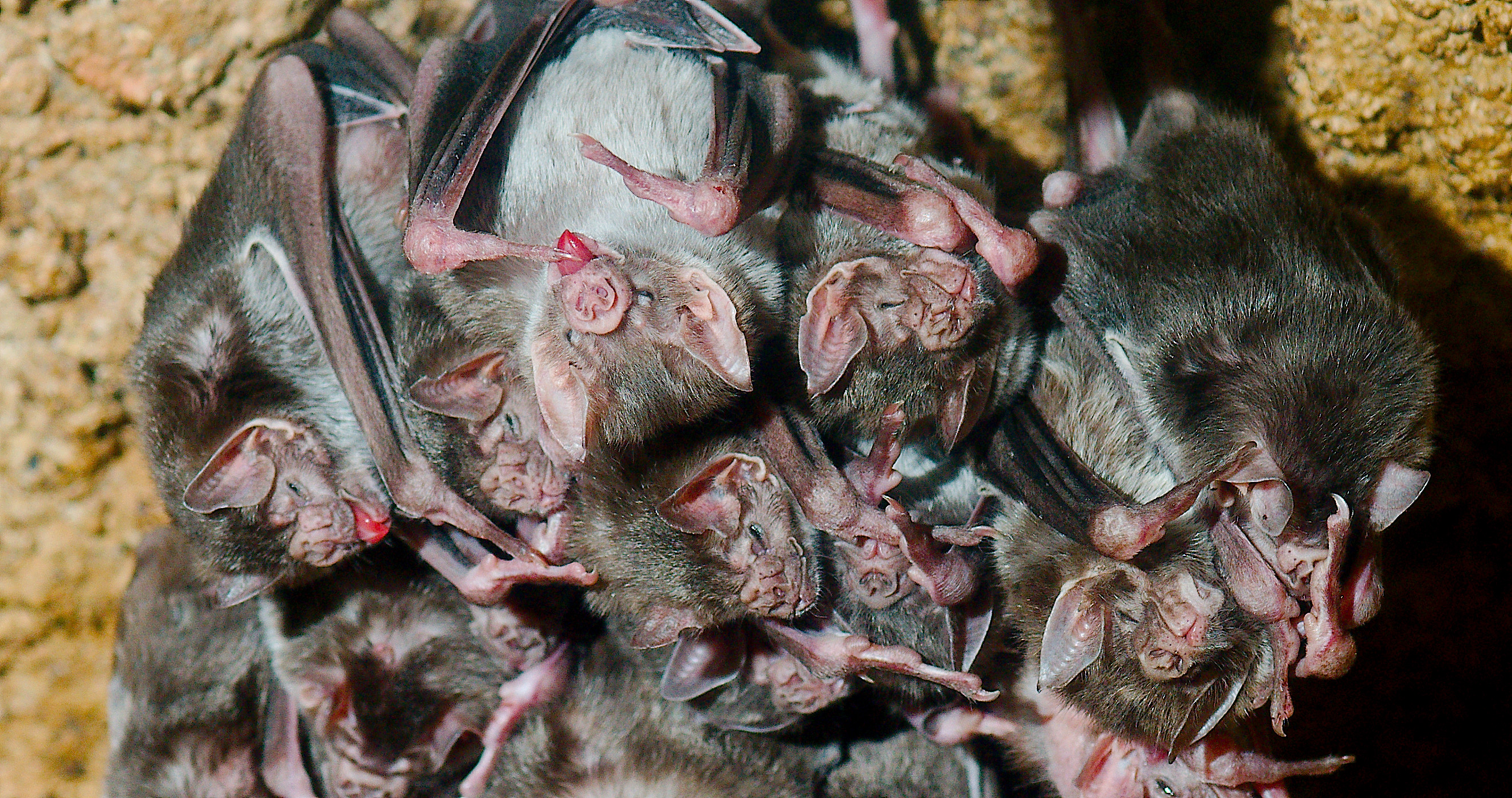
Vampire bats (Desmodus rotundus) are a highly social species. What happens to their social interactions when individuals get sick?
Credit: Josh More
Media Contact
Beth King
As Italy urges tourists not to cancel their plans in the face of the coronavirus outbreak and a National Basketball Association memo reportedly encourages teammates to avoid high-fives, a new study conducted at the Smithsonian Tropical Research Institute (STRI) in Panama takes a look at how social bonds change in response to illness in another highly social animal: the vampire bat. In these bats, just as in humans, strong family bonds were less affected by the appearance of disease than were weaker social relationships.
Vampire bats are an extremely social species. Their interactions range from grooming family members and unrelated individuals to saving another bat from starvation by sharing a regurgitated blood meal.
“By asking how different social connections change in response to sickness, we can better understand how social networks change as a pathogen spreads,” said Gerry Carter, research associate at STRI and assistant professor of biology at The Ohio State University.
The lead author of the paper, Sebastian Stockmaier, did this project at STRI as part of his doctoral research at the University of Texas at Austin, advised by Daniel Bolnick at the University of Connecticut. Stockmaier injected vampire bats in a captive colony with a bacterial extract that challenged their immune systems, making them feel sick without harming their health or any risk of transmission. He then observed how the appearance of being sick would affect the ill bats’ social relationships with other colony members.
Just as a sick person might choose to stop shaking hands with strangers, but would still need to go to buy groceries, their results, published in the Journal of Animal Ecology, showed that sick vampire bats may reduce the amount of time they spend grooming—not a very important social interaction—but not food sharing—a more important social interaction.
Family relationships are very important: “A female vampire bat is less likely to groom an unrelated bat that is sick, but she won’t reduce the amount of time grooming her own sick offspring,” Stockmaier said.
“What we demonstrated in this study is that the type of social connection matters,” Carter said. “Just as in the recent COVID-19 outbreak, we would expect that a virus transmitted by contact would spread mainly within family groups, because these social connections will not be reduced by sickness behavior. In vampire bats, as well as in humans, the most important social behaviors and relationships don’t change as much when individuals are sick.”
“This study underlies the importance of basic research,” said Rachel Page, research biologist at STRI and a co-author of the paper. “Understanding how social interactions change in the face of illness is a key component in predicting the channels and speed at which a pathogen can spread across a population. Close observation of vampire bat behavior sheds light on how social animals interact, and how these interactions change—and importantly, when they do not change but persist—as individuals become sick.”
The Smithsonian Tropical Research Institute, headquartered in Panama City, Panama, is a unit of the Smithsonian Institution. The institute furthers the understanding of tropical biodiversity and its importance to human welfare, trains students to conduct research in the tropics and promotes conservation by increasing public awareness of the beauty and importance of tropical ecosystems. Promo video.
# # #
SI-93-2020
Stockmaier, S., Bolnick, D.I., Page, R.A. and Carter, G.G. 2020. Sickness effects on social interactions depend on the type of behavior and relationship. Journal of Animal Ecology. https://doi.org/10.1111/1365-2656.13193