
National Museum of Asian Art
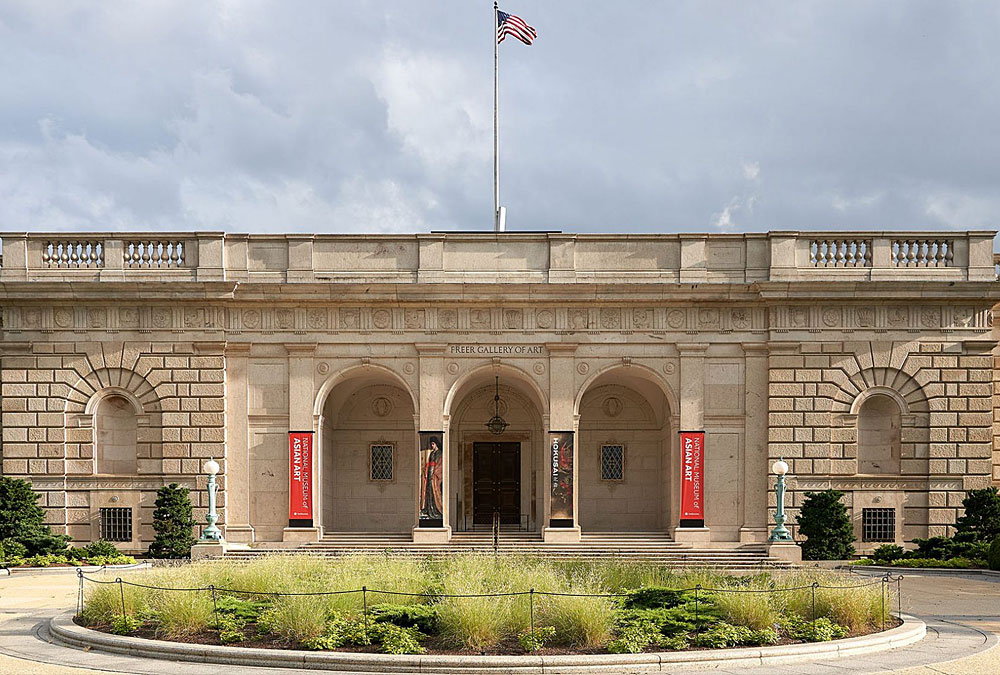
Director: Chase F. Robinson
Location:
West Building Mall Entrance (Freer Gallery of Art):
Near the National Mall
1200 Jefferson Dr. S.W.
Washington, D.C.
East Building Garden Entrance (Arthur M. Sackler Gallery):
Near the Enid A. Haupt Garden
1050 Independence Ave. S.W.
Washington, D.C.
Overview
The Smithsonian’s National Museum of Asian Art is committed to preserving, exhibiting, researching and interpreting art in ways that deepen the public and scholarly understandings of Asia and the world. The museum opened in 1923 as America’s first national art museum and the first Asian art museum in the United States. It now stewards one of the world’s most important collections of Asian art, with works dating from antiquity to the present. The museum also stewards an important collection of 19th- and early 20th-century American art.
Today, the National Museum of Asian Art is emerging as a leading national and global resource for understanding the arts, cultures and societies of Asia, especially at their intersection with America. Guided by the belief that the future of art museums lies in collaboration, increased access and transparency, the museum is fostering new ways to engage with its audiences while enhancing its commitment to excellence.
Located on the National Mall in Washington, D.C., the museum is free and open 364 days a year (closed Dec. 25). The Smithsonian, which is the world’s largest museum, education and research complex, welcomes 20–30 million visitors yearly. For more information about the National Museum of Asian Art, visit asia.si.edu.
Centennial
The National Museum of Asian Art celebrated its 100th anniversary with a series of exhibitions, programs, performances and other special events that culminated with a two-week festival during Asian Pacific American Heritage Month that was attended by more than 40,000 people.
Bank of America was the Presenting Sponsor for the centennial celebrations. Sponsorship included support for May programming that commemorates Asian Pacific American Heritage Month for five years, greatly expanding the museum’s public programming, both within its galleries and on the National Mall, to ensure that Asian arts and culture reach the broadest possible audiences.
In addition, the museum honored its centennial by commissioning Abiding Nowhere, a film from Taiwan-based director Tsai Ming-liang that was screened during the Berlinale Special portion of the acclaimed Berlin International Film Festival (known as the Berlinale).
Founding History
The Freer Gallery of Art, now part of the National Museum of Asian Art, opened to the public in 1923. But its story began in 1906, when Charles Lang Freer, a prominent figure in the railroad industry, gave his collection of Asian and American art to the nation, a gift he had proposed to President Theodore Roosevelt a year before. By exploring the differences in arts from around the world, the Freer Gallery would unite, in Freer’s own words, “modern work with masterpieces of certain periods of high civilization harmonious in spiritual suggestion.” Throughout its nearly 100-year history, the gallery has enabled visitors to view American paintings from the Aesthetic movement of the late 19th century, as well as the arts of China, Egypt, the Indian subcontinent, Japan, Korea and the Islamic world.
In 1987, the Arthur M. Sackler Gallery opened adding to the museum’s footprint and collection of Asian art. The museum was named by the Smithsonian in recognition of Arthur M. Sackler’s gift of 1,000 objects, including incomparable examples of Chinese jades and bronzes among other important works.
The two galleries are united administratively and joined physically as the National Museum of Asian Art. This new brand was initiated in 2019 and endorsed by the U.S. Congress in 2024 at the culmination of the museum’s centennial, enabling the organization to officially begin its second century as the National Museum of Asian Art.
Collections
Containing more than 46,000 objects, the collection of the National Museum of Asian Art leads globally in a number of regions and periods. Highlights include:
- An internationally renowned collection of Egyptian glass vessels produced during Dynasty 18 (ca. 1539– 1295 B.C.)
- One of the most important collections of biblical manuscripts outside of Europe, including the world’s oldest Greek parchment manuscripts of the gospels
- One of the finest museum holdings of Chinese art in the world, totaling 13,000 objects, including ancient jades and bronzes, early Buddhist sculpture, imperial and trade ceramics, lacquer, classical paintings and calligraphy
- More than 15,000 Japanese objects—books, calligraphy, ceramics, lacquer, photographs and prints—spanning four millennia
- One of America’s preeminent collections of the arts of the Islamic world, with particular strengths in illustrated manuscripts and ceramics among the more than 2,200 objects
- The world’s largest collection of diverse works by James McNeill Whistler, including the famed Peacock Room
Conservation
The National Museum of Asian Art’s Department of Conservation and Scientific Research began with the hiring of Japanese painting mounters and the establishment of the East Asian Painting Conservation Studio in 1932. This facility remains one of the few in the U.S. that specializes in the conservation of Asian paintings. The technical laboratory was established in 1951 and is the first Smithsonian facility devoted to the use of scientific methods for the study of works of art. The technical laboratory’s work has expanded to include objects, paper and exhibits conservation.
Celebrations
The museum draws on cultural traditions from across Asia in festivals and events for visitors of all ages with art, music, theater, dance and food. Signature celebrations include:
- National Museum of Asian Art’s IlluminAsia: Arts and Culture Festival, an annual celebration of Asian arts and culture during Asian American and Native Hawaiian Pacific Islander Heritage Month
- Chuseok, the Korean “autumn evening” festival
- Diwali, the Hindu festival of light
- Lunar New Year, celebrated in different regions across Asia to mark the arrival of spring and the beginning of a new year on the lunisolar calendar
- National Cherry Blossom Festival, honoring the friendship between Japan and the U.S.
- Nowruz, commemorating the Persian New Year
The 2025 Lunar New Year celebration drew over 15,000 visitors—the museum’s highest single-day visitation in recent years.
Film Program
Begun in 1996, the National Museum of Asian Art’s film program presents year-round free screenings of films from across Asia in the 300-seat Meyer Auditorium, which features both state-of-the-art digital capabilities and the capacity to project archival formats such as 35 mm and 16 mm film. Notable director, writers and performers who have made personal appearances for Q&As include Tsai Ming-liang, Park Chan-wook, Jia Zhangke, Tatsuya Nakadai, Viet Thanh Nguyen and many others.
Education
The National Museum of Asian Art is committed to providing quality pre-K–12 programs that deepen students’ understanding of Asian arts and cultures, develop capacity for slow looking and broaden perspective-taking capacities. Examples include the classroom curriculum guide “Teaching China with the Smithsonian,” the virtual program “Artful Movement,” which combines mindful movement with slow looking at art, and a partnership with Fairfax County Public Schools in Virginia that brought thousands of sixth graders to the museum.
Provenance
Researching and documenting provenance—the history of an object’s ownership, from its creation to the present—are core activities of the National Museum of Asian Art, and the museum’s team of four full-time provenance researchers is an unprecedented number for a museum of its size. The museum’s ongoing portfolio of provenance research includes convening the first major symposium on Asian art provenance research in November 2023. In April 2025, the museum appointed an associate director of provenance and object histories to set the strategic direction for the museum’s expanded provenance program, enhance research efforts and increase the number of staff engaged in collection histories.
Global Affairs
The National Museum of Asian Art has engaged with cultural and government stakeholders internationally since its founding. Building on this historical legacy, the museum has significantly expanded its global partnerships in the past five years, advancing international collaboration through formal agreements, joint research projects and training initiatives. In February 2023, the museum established a historic partnership with the Republic of Yemen Government to care for repatriated objects from the Department of Homeland Investigations, reinforcing its role in supporting nations reclaiming their cultural heritage. In April 2025, the museum appointed an associate director for global affairs to oversee the museum’s international partnerships.
# # #
SI-215-2025