
We Hold These Truths To Be Self-Evident
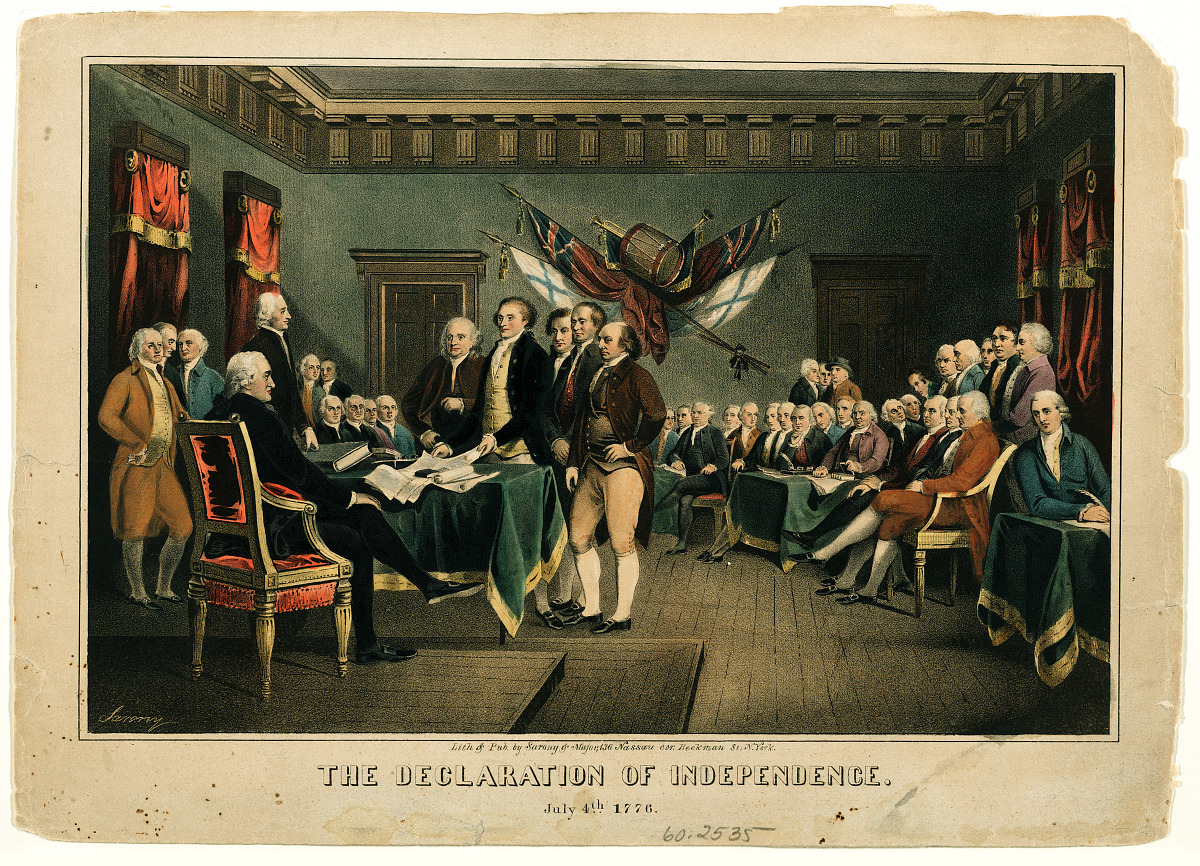
Napoleon Sarony, “The Declaration of Independence,” 1843–1853. Harry T. Peters, “America on Stone.” Lithography Collection. Smithsonian’s National Museum of American History
This hand-colored lithograph (1843–1853) was based on a painting by John Trumbull (1756–1843) that depicted the composers and signers of the Declaration of Independence in a fanciful depiction of the Assembly Room at Carpenter’s Hall in Philadelphia. The president of the Second Continental Congress, John Hancock, sits in an upholstered armchair at a table in the foreground.
The original 1786 painting by Trumbull shows the drafting committee presenting their draft to the Second Continental Congress, which took place June 28, 1776. It is not the signing, which mostly occurred between July 2 and Aug. 2, even though the caption implies that the scene is from July 4, 1776. Thomas Jefferson, as the principal drafter of the Declaration, is handing it to Hancock. John Adams, Benjamin Franklin, Roger Sherman and Robert Livingston, the other committee members, are standing with him. Forty-two of the 56 signers are also depicted, as are the few members of Congress who took part in the debates but did not sign the document.
Trumbull was an officer in the war, known for portraits and paintings of the leaders and events of the American Revolution. He created the image representing the Second Continental Congress and the Declaration of Independence by interviewing Jefferson in Paris. Then he returned to sketch Adams and 36 out of the 48 delegates to preserve their likenesses for history. Trumbull insisted on the portraits being drawn “from life” for authenticity and worked on the image for more than three decades. He created two other versions; one is the 1817–1818 painting in the rotunda of the U.S. Capitol. This lithograph is a reverse orientation or mirror image of the Trumbull paintings, with Hancock seated in the left foreground rather than the right as in the original paintings.
Napoleon Sarony (1821–1896), the graphic artist and lithographer, was born in Quebec and trained under several New York lithographic firms, including working with Nathaniel Currier, before creating the firm of Sarony & Major, publishers of this lithograph. Unlike the expensive engraving of this image by Asher B. Durand, the invention of lithography made this image economical and accessible. It became common in classrooms, public buildings, and textbooks throughout the 19th and 20th centuries.
This lithograph is in the collection of the Smithsonian’s National Museum of American History. It is not currently on view. See portraits of the signers of the Declaration of Independence and Thomas Jefferson’s desk in the Smithsonian’s collections.