Skip to main content Skip to main navigation
heart-solid My Visit Donate
Home Smithsonian Institution IK development site for ODI
Press Enter to activate a submenu, down arrow to access the items and Escape to close the submenu.
    • Overview
    • Museums and Zoo
    • Entry and Guidelines
    • Museum Maps
    • Dine and Shop
    • Accessibility
    • Visiting with Kids
    • Group Visits
    • Overview
    • Exhibitions
    • Online Events
    • All Events
    • IMAX & Planetarium
    • Overview
    • Topics
    • Collections
    • Research Resources
    • Stories
    • Podcasts
    • Overview
    • For Caregivers
    • For Educators
    • For Students
    • For Academics
    • For Lifelong Learners
    • Overview
    • Become a Member
    • Renew Membership
    • Make a Gift
    • Volunteer
    • Overview
    • Our Organization
    • Our Leadership
    • Reports and Plans
    • Newsdesk
heart-solid My Visit Donate
  1. Home
  2. forward-slash
  3. Explore
  4. forward-slash
  5. Collections
  6. forward-slash
  7. Smithsonian Snapshot
  8. forward-slash
  9. Vera Rubin: Lifelong Astronomer

Explore

  • Overview
  • Topics
    • Art & Design
    • History & Culture
    • Science & Nature
    • Tech & Innovation
  • Collections
    • Open Access
    • Smithsonian Snapshot
    • Collection Spotlights
  • Research Resources
    • Libraries
    • Archives
  • Stories
  • Podcasts
Smithsonian Snapshot

Vera Rubin: Lifelong Astronomer
March 20, 2019
Vera Rubin

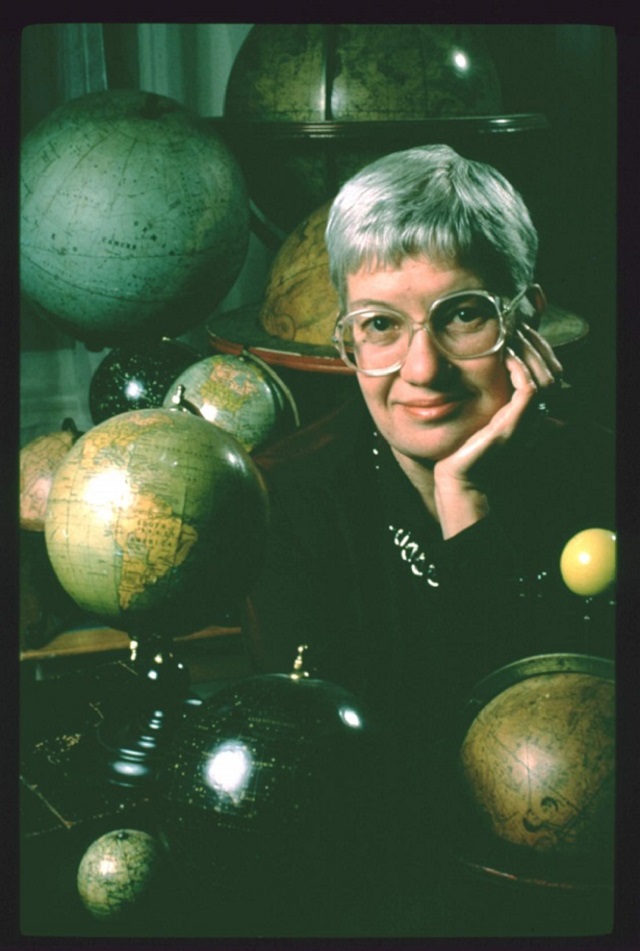
Vera Rubin among the many globes she collected, circa 1992. Smithsonian’s National Air and Space Museum.

“Each one of you can change the world, for you are made of star stuff, and you are connected to the universe.” —Vera Rubin, graduation address to University of California, Berkeley class of 1996

Astronomer Vera Rubin (1928–2016) is best known for finding evidence of “dark matter.” In 1977, she determined that about 90 percent of the mass in the universe is of unknown origin and cannot be seen, but it can be detected by how it distorts the behavior and motion of matter that can be seen, such as planets, stars and galaxies.

Rubin’s observations were a result of her collaboration with W. Kent Ford, an astronomer and instrument designer. Ford had built a special spectrograph that used a new optical amplifier; Rubin took the spectrograph to the powerful telescopes in the West to observe the universe. Rubin and Ford recorded spectroscopic signatures of tiny portions of distant galaxies and confirmed dark matter.

Rubin spent nearly her entire career at the Carnegie Institution of Science where she continued to study the large-scale motion of galaxies and galaxy clusters. She broke barriers for women and was widely regarded as a role model and mentor to women scientists.

Read more about Rubin on the Smithsonian’s National Air and Space Museum website: Women in Aviation and Space History: Vera Cooper Rubin and Capturing the Essence of Astronomer Vera Rubin. View the spectrograph Rubin and Ford developed in the museum’s collection. Discover more in our Smithsonian Spotlight on Women in Science.

arrow-up Back to top
Home
  • Facebook facebook
  • Instagram instagram
  • LinkedIn linkedin
  • YouTube youtube

  • Contact Us
  • Get Involved
  • Shop Online
  • Job Opportunities
  • Equal Opportunity
  • Inspector General
  • Records Requests
  • Accessibility
  • Host Your Event
  • Press Room
  • Privacy
  • Terms of Use