Skip to main content Skip to main navigation
heart-solid My Visit Donate
Home Smithsonian Institution IK development site for ODI
Press Enter to activate a submenu, down arrow to access the items and Escape to close the submenu.
    • Overview
    • Museums and Zoo
    • Entry and Guidelines
    • Museum Maps
    • Dine and Shop
    • Accessibility
    • Visiting with Kids
    • Group Visits
    • Overview
    • Exhibitions
    • Online Events
    • All Events
    • IMAX & Planetarium
    • Overview
    • Topics
    • Collections
    • Research Resources
    • Stories
    • Podcasts
    • Overview
    • For Caregivers
    • For Educators
    • For Students
    • For Academics
    • For Lifelong Learners
    • Overview
    • Become a Member
    • Renew Membership
    • Make a Gift
    • Volunteer
    • Overview
    • Our Organization
    • Our Leadership
    • Reports and Plans
    • Newsdesk
heart-solid My Visit Donate
  1. Home
  2. forward-slash
  3. Explore
  4. forward-slash
  5. Collections
  6. forward-slash
  7. Smithsonian Snapshot
  8. forward-slash
  9. To Tell the Tooth

Explore

  • Overview
  • Topics
    • Art & Design
    • History & Culture
    • Science & Nature
    • Tech & Innovation
  • Collections
    • Open Access
    • Smithsonian Snapshot
    • Collection Spotlights
  • Research Resources
    • Libraries
    • Archives
  • Stories
  • Podcasts
Smithsonian Snapshot

To Tell the Tooth

September 20, 2023
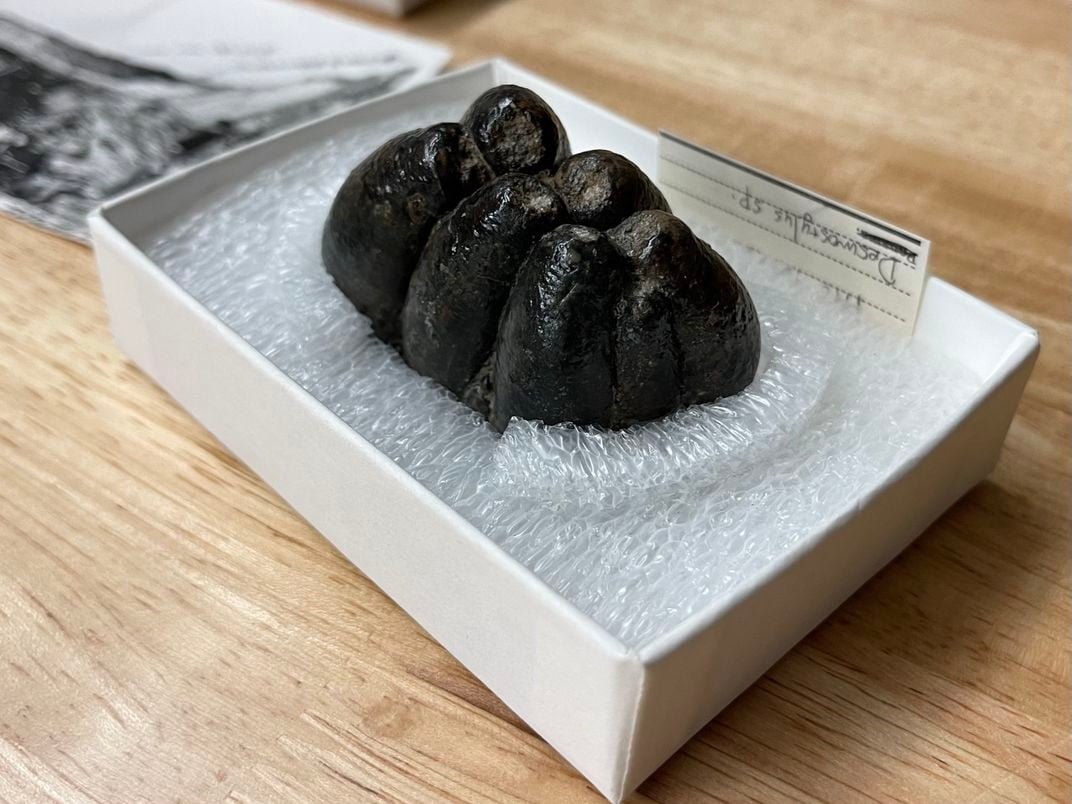
Desmostylus Tooth

Desmostylus Tooth. Jack Tamisiea, Smithsonian's National Museum of Natural History

Smithsonian researchers rediscovered a tooth from an ancient hippo-like marine mammal in the National Museum of Natural History’s collection.

Postdoctoral researcher Kumiko Matsui was looking through a cabinet in the museum’s paleobiology collection during the summer of 2021 when she came across a fossil tooth in one of the drawers that she knew belonged to a desmostylian, an extinct group of marine mammals that inhabited coastlines along the Pacific Rim.

But identifying the ‘Desmo’ species the tooth belonged to was more difficult. The fossil was originally discovered by Warren Addicott, a paleontologist at the U.S. Geological Survey, in 1965. To pinpoint the exact rock formation where Addicott uncovered the curious chomper, Matsui and Nicholas Pyenson, the museum’s curator of fossil marine mammals, examined archival museum records, including a faded, handwritten label and a sepia-tinted photograph of the dig site.

Matsui and Pyenson linked the tooth to Desmostylus, a species of desmostylian previously thought to originate much later in the Miocene. According to Matsui, the fossilized molar reveals that Desmostylus sported these specialized, column-like teeth that resemble a bundle of rods encased in thick enamel for more than 15 million years.

These aquatic herbivores did not chew or eat like any other known animal. To root up aquatic plants, they clenched their mouthful of oddly shaped molars together. The unusual structure of their mouths and strong muscles helped them suck in the food.

To see what desmostylia looked like, check out the artist’s rendering on the museum’s Ocean Portal website.

arrow-up Back to top
Home
  • Facebook facebook
  • Instagram instagram
  • LinkedIn linkedin
  • YouTube youtube

  • Contact Us
  • Get Involved
  • Shop Online
  • Job Opportunities
  • Equal Opportunity
  • Inspector General
  • Records Requests
  • Accessibility
  • Host Your Event
  • Press Room
  • Privacy
  • Terms of Use