Skip to main content Skip to main navigation
heart-solid My Visit Donate
Home Smithsonian Institution IK development site for ODI
Press Enter to activate a submenu, down arrow to access the items and Escape to close the submenu.
    • Overview
    • Museums and Zoo
    • Entry and Guidelines
    • Museum Maps
    • Dine and Shop
    • Accessibility
    • Visiting with Kids
    • Group Visits
    • Overview
    • Exhibitions
    • Online Events
    • All Events
    • IMAX & Planetarium
    • Overview
    • Topics
    • Collections
    • Research Resources
    • Stories
    • Podcasts
    • Overview
    • For Caregivers
    • For Educators
    • For Students
    • For Academics
    • For Lifelong Learners
    • Overview
    • Become a Member
    • Renew Membership
    • Make a Gift
    • Volunteer
    • Overview
    • Our Organization
    • Our Leadership
    • Reports and Plans
    • Newsdesk
heart-solid My Visit Donate
  1. Home
  2. forward-slash
  3. Explore
  4. forward-slash
  5. Collections
  6. forward-slash
  7. Smithsonian Snapshot
  8. forward-slash
  9. Strawberry Dart Frog

Explore

  • Overview
  • Topics
    • Art & Design
    • History & Culture
    • Science & Nature
    • Tech & Innovation
  • Collections
    • Open Access
    • Smithsonian Snapshot
    • Collection Spotlights
  • Research Resources
    • Libraries
    • Archives
  • Stories
  • Podcasts
Smithsonian Snapshot

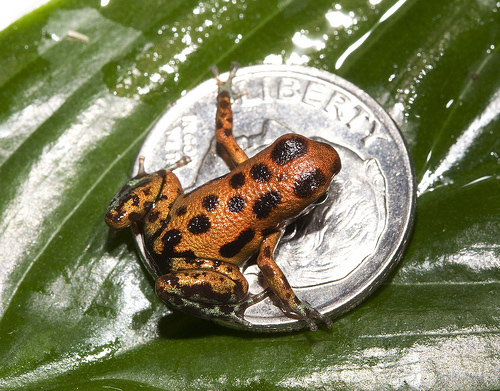
Strawberry Dart Frog
April 26, 2011
Strawberry Dart Frog, 2009

Strawberry Dart Frog, 2009, Smithsonian’s National Zoo

Vibrant but toxic, poison arrow frogs range from less than 1 inch to 2.5 inches in body length. Poison arrow frogs live in the rainforests of Central and South America and on a few Hawaiian Islands.

It is said that poison arrow frogs, also called poison dart frogs, received their name because some Amerindian tribes used their skin secretions to poison their darts. Arrow frogs are not poisonous in captivity. Scientists believe that these frogs gain their poison from specific insects they eat in the wild.

Strawberry dart frogs are one of more than 100 species of poison dart frog. The strawberry dart frog’s reproductive process starts in thick foliage close to the ground, where the female lays about six eggs—each no bigger than a pea—in a moist place after mating. For about the next 10 days, the frogs protect and water the clutch by urinating on it. When the eggs hatch, the female carries each tadpole on her back, one at a time, up the side of a tree in search of a small pool of water, less than a thimble’s worth, where she can deposit them. This can be a tree cavity, but many frogs use pools in bromeliad plants, which often grow high up on trees.

The Smithsonian Conservation Biology Institute is leading a partner project in Panama to save amphibians like these from a disease—chytrid—wiping them out worldwide. Eastern Panama, in particular, represents the last stronghold for amphibian biodiversity. Smithsonian researchers have built an amphibian rescue pod there to safeguard nearly 20 Panamanian frog species in imminent danger of extinction as the wave of chytrid moves through their habitat. You can read more about SCBI’s efforts.

 
arrow-up Back to top
Home
  • Facebook facebook
  • Instagram instagram
  • LinkedIn linkedin
  • YouTube youtube

  • Contact Us
  • Get Involved
  • Shop Online
  • Job Opportunities
  • Equal Opportunity
  • Inspector General
  • Records Requests
  • Accessibility
  • Host Your Event
  • Press Room
  • Privacy
  • Terms of Use