Skip to main content Skip to main navigation
heart-solid My Visit Donate
Home Smithsonian Institution IK development site for ODI
Press Enter to activate a submenu, down arrow to access the items and Escape to close the submenu.
    • Overview
    • Museums and Zoo
    • Entry and Guidelines
    • Museum Maps
    • Dine and Shop
    • Accessibility
    • Visiting with Kids
    • Group Visits
    • Overview
    • Exhibitions
    • Online Events
    • All Events
    • IMAX & Planetarium
    • Overview
    • Topics
    • Collections
    • Research Resources
    • Stories
    • Podcasts
    • Overview
    • For Caregivers
    • For Educators
    • For Students
    • For Academics
    • For Lifelong Learners
    • Overview
    • Become a Member
    • Renew Membership
    • Make a Gift
    • Volunteer
    • Overview
    • Our Organization
    • Our Leadership
    • Reports and Plans
    • Newsdesk
heart-solid My Visit Donate
  1. Home
  2. forward-slash
  3. Explore
  4. forward-slash
  5. Collections
  6. forward-slash
  7. Smithsonian Snapshot
  8. forward-slash
  9. Shedding Light on the Sun

Explore

  • Overview
  • Topics
    • Art & Design
    • History & Culture
    • Science & Nature
    • Tech & Innovation
  • Collections
    • Open Access
    • Smithsonian Snapshot
    • Collection Spotlights
  • Research Resources
    • Libraries
    • Archives
  • Stories
  • Podcasts
Smithsonian Snapshot

Shedding Light on the Sun
December 16, 2021
Solar Probe Cup

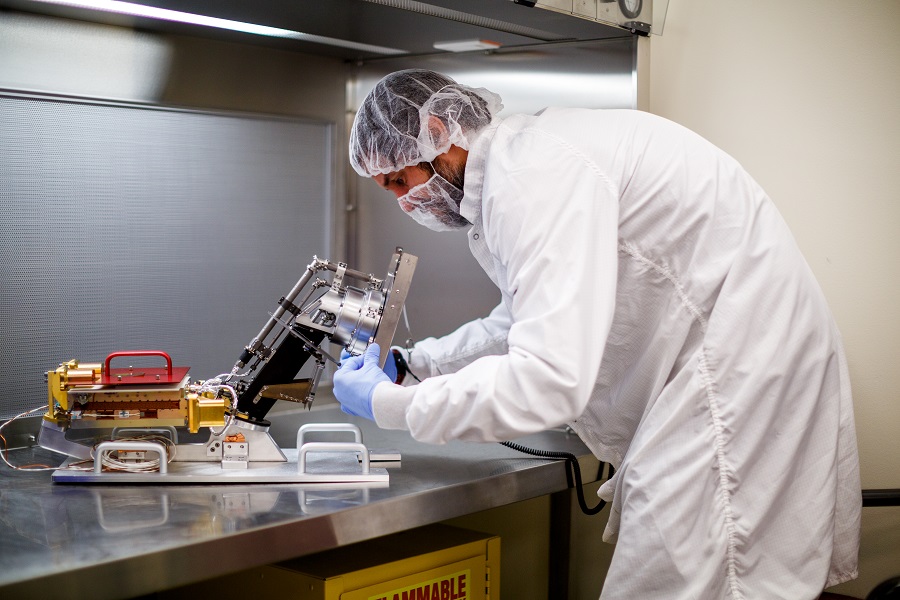
Tony Case, astrophysicist, Center for Astrophysics | Harvard & Smithsonian, 2018. Photo by Andrew Wang.

Astrophysicist Tony Case and other scientists at the Center for Astrophysics | Harvard & Smithsonian (CfA) helped NASA do what was once thought impossible: launch a spacecraft that "touched” the sun. In April 2021, the Parker Solar Probe spacecraft entered the corona of the sun—an extreme environment that is roughly 2 million degrees Fahrenheit.

The CfA built the spacecraft’s Solar Probe Cup, pictured above with Case, designing it to withstand extraordinary temperatures. The cup collects particles from the sun’s atmosphere, which helped scientists verify the probe had entered the sun’s corona. While making its measurements, the cup is directly exposed to the sunlight and is literally red-hot; parts of the instrument are more than 1,800 degrees Fahrenheit [1,000 degrees Celsius], glowing with a fiery intensity.

According to data collected by the cup, the spacecraft entered the corona three times April 28, at one point for up to five hours.

To avoid degradation, the device is constructed of materials that have high melting points, like tungsten, niobium, molybdenum and sapphire.

Scientists do not know why the outer atmosphere of the sun is so much hotter (about 3.6 million degrees Fahrenheit [2 million degrees Celsius]) than the sun itself (10,000 degrees Fahrenheit [5,500 degrees Celsius]).

Outbursts from the sun, like solar flares and high-speed solar winds, can have a direct impact on Earth, disrupting power grids and radio communication. The Parker Solar Probe can help better understand all these phenomena as it continues to orbit the sun and take measurements and data for scientists to analyze.

arrow-up Back to top
Home
  • Facebook facebook
  • Instagram instagram
  • LinkedIn linkedin
  • YouTube youtube

  • Contact Us
  • Get Involved
  • Shop Online
  • Job Opportunities
  • Equal Opportunity
  • Inspector General
  • Records Requests
  • Accessibility
  • Host Your Event
  • Press Room
  • Privacy
  • Terms of Use