Skip to main content Skip to main navigation
heart-solid My Visit Donate
Home Smithsonian Institution IK development site for ODI
Press Enter to activate a submenu, down arrow to access the items and Escape to close the submenu.
    • Overview
    • Museums and Zoo
    • Entry and Guidelines
    • Museum Maps
    • Dine and Shop
    • Accessibility
    • Visiting with Kids
    • Group Visits
    • Overview
    • Exhibitions
    • Online Events
    • All Events
    • IMAX & Planetarium
    • Overview
    • Topics
    • Collections
    • Research Resources
    • Stories
    • Podcasts
    • Overview
    • For Caregivers
    • For Educators
    • For Students
    • For Academics
    • For Lifelong Learners
    • Overview
    • Become a Member
    • Renew Membership
    • Make a Gift
    • Volunteer
    • Overview
    • Our Organization
    • Our Leadership
    • Reports and Plans
    • Newsdesk
heart-solid My Visit Donate
  1. Home
  2. forward-slash
  3. Explore
  4. forward-slash
  5. Collections
  6. forward-slash
  7. Smithsonian Snapshot
  8. forward-slash
  9. A Patently Better Egg

Explore

  • Overview
  • Topics
    • Art & Design
    • History & Culture
    • Science & Nature
    • Tech & Innovation
  • Collections
    • Open Access
    • Smithsonian Snapshot
    • Collection Spotlights
  • Research Resources
    • Libraries
    • Archives
  • Stories
  • Podcasts
Smithsonian Snapshot

A Patently Better Egg
August 16, 2018
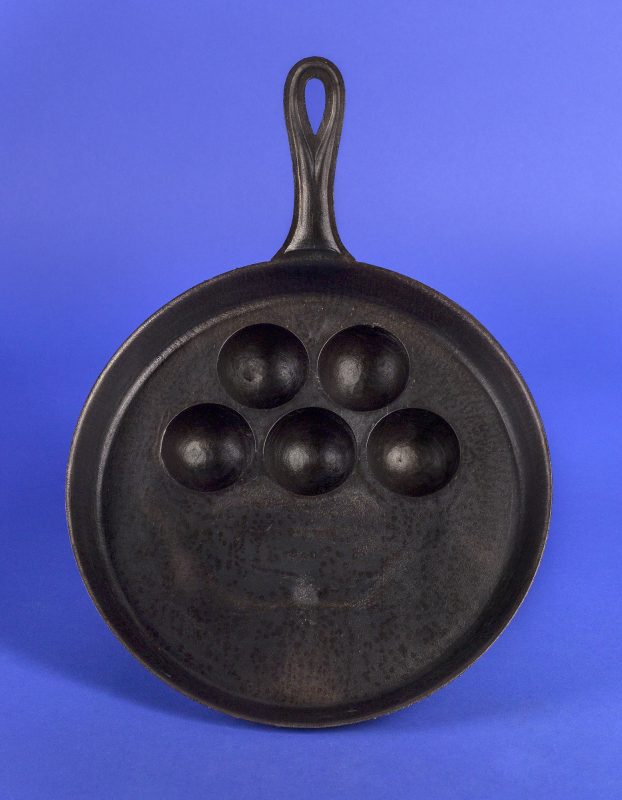
iron egg pan

“Ham and Egg Frier,” patented Oct. 18, 1870

In the late 19th century, an eggs-ellent idea came to Elizabeth L. Packard: to build a better frying pan, one with dimples to keep eggs in place while cooking. The model of her invention, the “Ham and Egg Frier,” patented Oct. 18, 1870, is pictured here.

Packard wrote in her patent application that in the process of frying eggs, the albumen (egg white) breaks, which “causes it to become widely and unevenly diffused over its bottom, whereby the outer portions thereof become so desiccated or burned, before the other parts are cooked, as to lose their distinctive character and become insipid or tasteless. My invention obviates this evil.” She also stated that the flat section was “intended for frying ham, meat, fish, &c.”—a complete one-pan breakfast.

Between 1790 and 1880, the U.S. Patent Office required not only documentation but also a 3-D model to demonstrate each new invention submitted for a patent. The models helped clarify how proposed innovations would work and enabled comparison against similar inventions.

The U.S. Patent Office transferred about 10,000 patent models to the U.S. National Museum at the Smithsonian between 1908 and 1926. They are now at the Smithsonian’s National Museum of American History. Packard’s frying pan is not currently on public display, but will be included in the exhibition “Inventive Minds: Women Inventors!” in 2019.

Visit the museum’s Lemelson Center for the Study of Invention and Innovation website to learn more about inventions and their patents.

arrow-up Back to top
Home
  • Facebook facebook
  • Instagram instagram
  • LinkedIn linkedin
  • YouTube youtube

  • Contact Us
  • Get Involved
  • Shop Online
  • Job Opportunities
  • Equal Opportunity
  • Inspector General
  • Records Requests
  • Accessibility
  • Host Your Event
  • Press Room
  • Privacy
  • Terms of Use