Skip to main content Skip to main navigation
heart-solid My Visit Donate
Home Smithsonian Institution IK development site for ODI
Press Enter to activate a submenu, down arrow to access the items and Escape to close the submenu.
    • Overview
    • Museums and Zoo
    • Entry and Guidelines
    • Museum Maps
    • Dine and Shop
    • Accessibility
    • Visiting with Kids
    • Group Visits
    • Overview
    • Exhibitions
    • Online Events
    • All Events
    • IMAX & Planetarium
    • Overview
    • Topics
    • Collections
    • Research Resources
    • Stories
    • Podcasts
    • Overview
    • For Caregivers
    • For Educators
    • For Students
    • For Academics
    • For Lifelong Learners
    • Overview
    • Become a Member
    • Renew Membership
    • Make a Gift
    • Volunteer
    • Overview
    • Our Organization
    • Our Leadership
    • Reports and Plans
    • Newsdesk
heart-solid My Visit Donate
  1. Home
  2. forward-slash
  3. Explore
  4. forward-slash
  5. Collections
  6. forward-slash
  7. Smithsonian Snapshot
  8. forward-slash
  9. Lexington Racehorse

Explore

  • Overview
  • Topics
    • Art & Design
    • History & Culture
    • Science & Nature
    • Tech & Innovation
  • Collections
    • Open Access
    • Smithsonian Snapshot
    • Collection Spotlights
  • Research Resources
    • Libraries
    • Archives
  • Stories
  • Podcasts
Smithsonian Snapshot

Lexington Racehorse

May 3, 2011
Lexington Racehorse, 1878

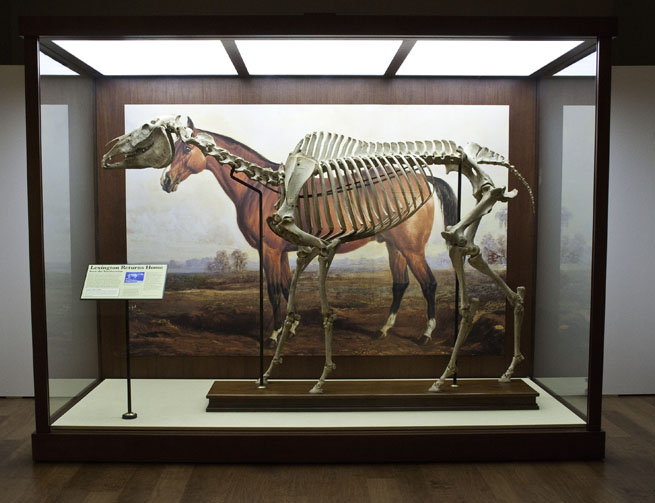
Lexington Racehorse, 1878, Photo courtesy of the International Museum of the Horse

Known as one of the greatest racehorses of his day and sire to more winning horses than any other American thoroughbred before or since, Lexington (1850-1875) is a symbol of the town of Lexington, Ky., which names him the “Official Horse of Bluegrass Country.”

Originally exhibited in the Osteology Hall at the National Museum of Natural History, Lexington was moved to the National Museum of American History in 1999 to be included in the exhibition “On Time.” His skeleton provided context to the story of the first mass-produced stopwatch that split time into fractions of seconds—allegedly developed to time Lexington’s feats on the racetrack.

In 2010, some 160 years after his birth, a team of conservators and specialists at the National Museum of Natural History prepared to return Lexington’s skeleton to his birthplace. They cleaned the bones, made minor repairs and prepared the skeleton for travel to the International Museum of the Horse, where the skeleton had been approved for loan just in time for the World Equestrian Games in Kentucky—the first time these games had ever been held outside Europe.

This object is one of more than 1,000 artifacts, works of art and specimens on view at Smithsonian Affiliates across the country. Lexington is on view at the International Museum of the Horse through August 2013.

arrow-up Back to top
Home
  • Facebook facebook
  • Instagram instagram
  • LinkedIn linkedin
  • YouTube youtube

  • Contact Us
  • Get Involved
  • Shop Online
  • Job Opportunities
  • Equal Opportunity
  • Inspector General
  • Records Requests
  • Accessibility
  • Host Your Event
  • Press Room
  • Privacy
  • Terms of Use