Skip to main content Skip to main navigation
heart-solid My Visit Donate
Home Smithsonian Institution IK development site for ODI
Press Enter to activate a submenu, down arrow to access the items and Escape to close the submenu.
    • Overview
    • Museums and Zoo
    • Entry and Guidelines
    • Museum Maps
    • Dine and Shop
    • Accessibility
    • Visiting with Kids
    • Group Visits
    • Overview
    • Exhibitions
    • Online Events
    • All Events
    • IMAX & Planetarium
    • Overview
    • Topics
    • Collections
    • Research Resources
    • Stories
    • Podcasts
    • Overview
    • For Caregivers
    • For Educators
    • For Students
    • For Academics
    • For Lifelong Learners
    • Overview
    • Become a Member
    • Renew Membership
    • Make a Gift
    • Volunteer
    • Overview
    • Our Organization
    • Our Leadership
    • Reports and Plans
    • Newsdesk
heart-solid My Visit Donate
  1. Home
  2. forward-slash
  3. Explore
  4. forward-slash
  5. Collections
  6. forward-slash
  7. Smithsonian Snapshot
  8. forward-slash
  9. First-Ever Image of a Black Hole

Explore

  • Overview
  • Topics
    • Art & Design
    • History & Culture
    • Science & Nature
    • Tech & Innovation
  • Collections
    • Open Access
    • Smithsonian Snapshot
    • Collection Spotlights
  • Research Resources
    • Libraries
    • Archives
  • Stories
  • Podcasts
Smithsonian Snapshot

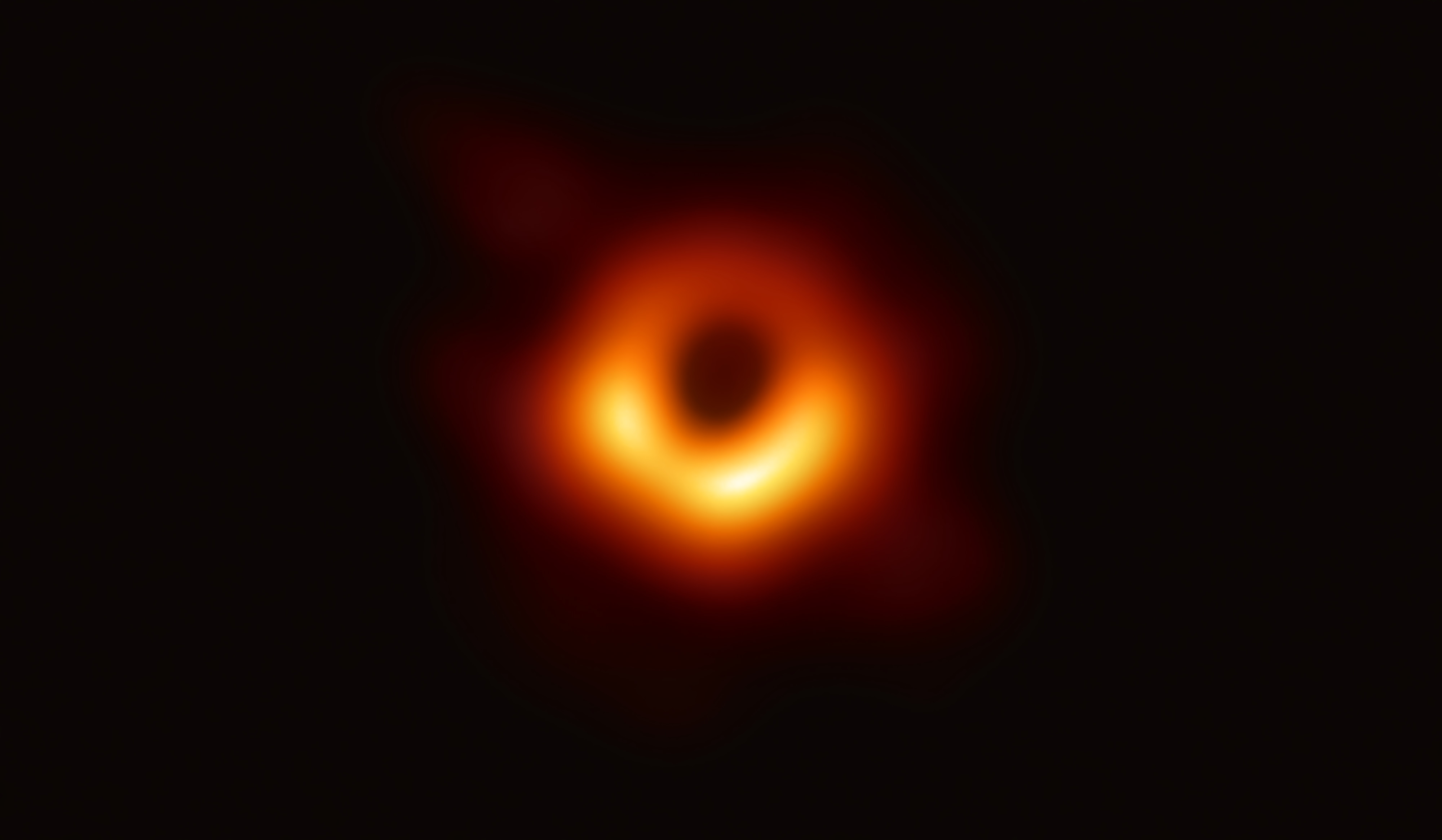
First-Ever Image of a Black Hole
April 10, 2019
black hole

Credit: Event Horizon Telescope Collaboration

This is the first-ever image of a black hole. Captured by the Event Horizon Telescope, or EHT, it reveals the supermassive black hole at the center of Messier 87, a massive galaxy 55 million light-years away.

Black holes are extremely compressed cosmic objects, containing extraordinary amounts of mass within a tiny region. (This one contains 6.5 billion times the mass of the Earth’s sun.) This mass is shrouded by an event horizon, the boundary beyond which nothing—not even light—can escape from the black hole’s powerful gravitational pull.

General relativity predicts that a black hole will cast a circular shadow on the bright, superheated material around it. This image reveals the shadow.

The EHT links eight telescopes around the globe to form an Earth-sized virtual telescope with unprecedented sensitivity and resolution. This achievement was made possible, in part, by leadership and funding from the Center for Astrophysics | Harvard & Smithsonian.

Learn more at the Event Horizon Telescope project website.

arrow-up Back to top
Home
  • Facebook facebook
  • Instagram instagram
  • LinkedIn linkedin
  • YouTube youtube

  • Contact Us
  • Get Involved
  • Shop Online
  • Job Opportunities
  • Equal Opportunity
  • Inspector General
  • Records Requests
  • Accessibility
  • Host Your Event
  • Press Room
  • Privacy
  • Terms of Use