
An Eloquent Argument
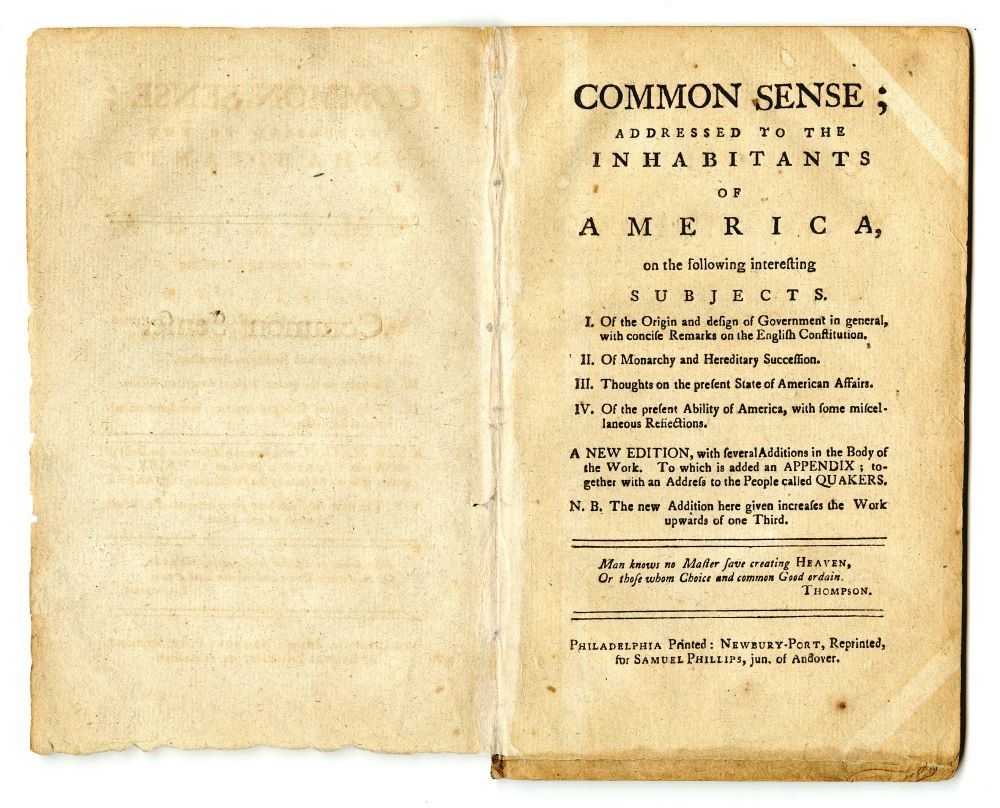
Pamphlet “Common Sense,” 1776. Smithsonian’s National Museum of American History.
“We have it in our power to begin the world over again,” Thomas Paine proclaimed in the pamphlet “Common Sense,” his argument against monarchy and hereditary privilege—and for American independence—that first appeared anonymously in Philadelphia in January 1776. Of course, that was not entirely true: The Revolutionaries could only change so much, in light of powerful opposition, internal divisions and their own attachments to familiar institutions. Nonetheless, Paine’s hyperbolic sentence captures the heady, extravagant sense of possibility that many colonists would experience in the extraordinary year of 1776.
Paine’s pamphlet—addressed to the common people and their common sense rather than the high and mighty—helped to animate the existing patriot movement in the colonies with brilliant writing, a ready willingness to dismiss the British king and a fierce commitment to actually representative government institutions.
“Common Sense” was so popular that 25 print editions appeared within a year; 120,000 copies were sold in its first three months and 500,000 copies by the end of the Revolution. An estimated 20% of colonists owned one. That astounding number testifies to the powerful reach of print media in the 18th century. Most free colonists were literate, accustomed to the circulation of books, newspapers and pamphlets issued from colonial presses as well as imported via the transatlantic trade. By 1776, they were accustomed to reading political arguments and debating political principles in public meetings, coffeehouses and taverns, and private homes.
Paine, born into an English artisan household, wrote in an accessible style for readers from a similar background. A more cautious Patriot, John Adams, worried that Paine’s radical pamphlet amounted to a “disastrous meteor” blazing across colonial societies.
Paine continued to boost morale during the American Revolution’s darkest days, beginning his series of “Crisis” essays (1776–83) with the words, “These are the times that try Men’s souls.” He went on to take part in Revolutionary events in France and to support Parliamentary reform in England.
The “Common Sense” pamphlet pictured above is in the collection of the Smithsonian’s National Museum of American History, where it is currently on display in “American Democracy: A Great Leap of Faith.” Learn more in the online exhibition “One Life: Thomas Paine” at the Smithsonian’s National Portrait Gallery and view its portrait of Paine.