Skip to main content Skip to main navigation
heart-solid My Visit Donate
Home Smithsonian Institution IK development site for ODI
Press Enter to activate a submenu, down arrow to access the items and Escape to close the submenu.
    • Overview
    • Museums and Zoo
    • Entry and Guidelines
    • Museum Maps
    • Dine and Shop
    • Accessibility
    • Visiting with Kids
    • Group Visits
    • Overview
    • Exhibitions
    • Online Events
    • All Events
    • IMAX & Planetarium
    • Overview
    • Topics
    • Collections
    • Research Resources
    • Stories
    • Podcasts
    • Overview
    • For Caregivers
    • For Educators
    • For Students
    • For Academics
    • For Lifelong Learners
    • Overview
    • Become a Member
    • Renew Membership
    • Make a Gift
    • Volunteer
    • Overview
    • Our Organization
    • Our Leadership
    • Reports and Plans
    • Newsdesk
heart-solid My Visit Donate
  1. Home
  2. forward-slash
  3. Explore
  4. forward-slash
  5. Collections
  6. forward-slash
  7. Smithsonian Snapshot
  8. forward-slash
  9. Apollo 11 Command Module

Explore

  • Overview
  • Topics
    • Art & Design
    • History & Culture
    • Science & Nature
    • Tech & Innovation
  • Collections
    • Open Access
    • Smithsonian Snapshot
    • Collection Spotlights
  • Research Resources
    • Libraries
    • Archives
  • Stories
  • Podcasts
Smithsonian Snapshot

Apollo 11 Command Module
July 19, 2011
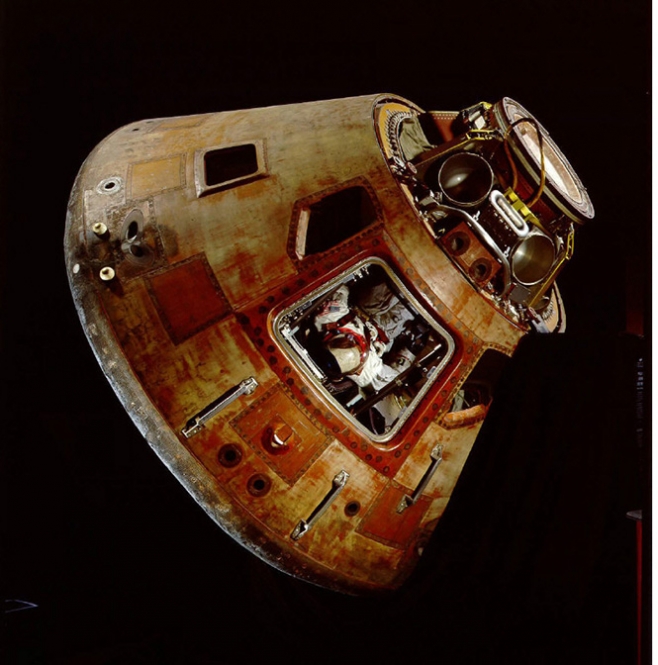
Apollo 11 Command Module "Columbia," 1969

Apollo 11 Command Module "Columbia," 1969, Smithsonian's National Air and Space Museum

On July 20, 1969, Neil Armstrong became the first human to set foot on the Earth’s moon.

On July 16, 1969, Armstrong, Edwin "Buzz" Aldrin and Michael Collins were launched from Cape Kennedy atop a Saturn V rocket. The Apollo 11 Command Module, "Columbia," was the living quarters for the three-person crew during most of the first manned lunar-landing mission.

This Command Module, no. 107, manufactured by North American Rockwell, was one of three parts of the complete Apollo spacecraft. The other two parts were the Service Module and the Lunar Module, nicknamed "Eagle." The Service Module contained the main spacecraft propulsion system and consumables while the Lunar Module was the two-person craft used by Armstrong and Aldrin to descend to the moon's surface July 20.

The Command Module is the only portion of the spacecraft to return to Earth.

It was transferred to the Smithsonian in 1970 following a NASA-sponsored tour of American cities.

arrow-up Back to top
Home
  • Facebook facebook
  • Instagram instagram
  • LinkedIn linkedin
  • YouTube youtube

  • Contact Us
  • Get Involved
  • Shop Online
  • Job Opportunities
  • Equal Opportunity
  • Inspector General
  • Records Requests
  • Accessibility
  • Host Your Event
  • Press Room
  • Privacy
  • Terms of Use